



The Rise of AI Agents in DeFi: Autonomous Trading and Beyond
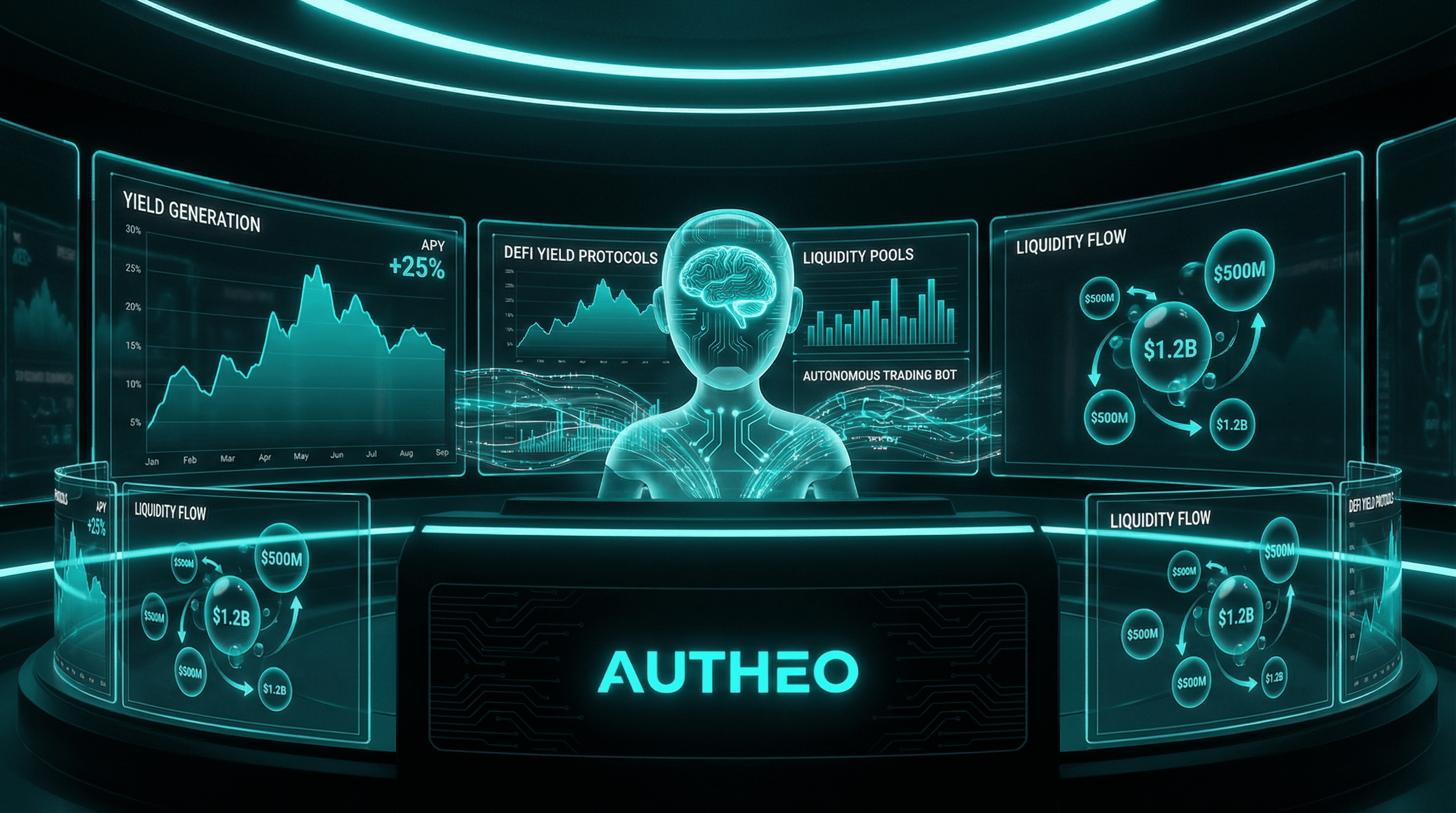
AI agents in DeFi are autonomous software programs that hold blockchain wallets, execute trades, manage yield positions, and monitor protocol health without human intervention, and in just seven months from November 2024 to June 2025, Arma Agents alone grew from $200,000 to $11.2 million in total value locked, handling $324 million in agentic volume across 33,000 active agents. This explosive growth signals that AI agents are no longer experimental, they are becoming a core layer of the DeFi ecosystem.
Loading tweet...
What Are DeFi AI Agents?
DeFi AI agents are intelligent, autonomous systems that combine machine learning with on-chain execution capabilities. Unlike traditional automated bots that follow fixed rules ("if interest rate > X%, move funds"), AI agents think contextually: they analyze real-time market conditions, factor in multiple variables simultaneously including gas fees, shifting APYs, liquidity conditions, and on-chain sentiment, then make adaptive decisions optimized for their operator's goals.
Three primary categories have emerged. Research Agents gather and analyze on-chain data, social media sentiment, and protocol metrics to surface actionable insights. UI Agents let users interact with DeFi protocols through natural language, "deposit 1000 USDC into the highest-yield stable pool", handling the transaction execution behind the scenes. Execution Agents are the heavy hitters: they autonomously deploy trading strategies, hunt for yield, rebalance allocations, and maximize returns around the clock without human oversight.
Yield Optimization: The Killer App
Yield optimization is the most mature AI agent use case in DeFi. These agents continuously monitor liquidity pools across multiple protocols, calculate the optimal balance of base APY, incentive rewards, gas costs, and impermanent loss risk, then move capital to maximize returns, sometimes rebalancing multiple times per day.
Arma Agents (launched November 2024) allocate USDC across DeFi protocols including Morpho, Moonwell, and Aave. TVL surged 5,500% from $200,000 to $11.2 million in seven months. Morpho Agents (by BrahmaFi) saw TVL grow 760% from $1.1 million to $9.5 million over six months. Summer.fi's Lazy Vaults have surpassed $80 million in TVL. By June 2025, stablecoin-focused AI agents had crossed $20 million in TVL on Base blockchain alone.
Arbitrage, Prediction Markets, and Cross-Chain Strategies
Arbitrage is another natural fit for AI agents. These systems scan decentralized exchanges, bridges, and rollups for price discrepancies in milliseconds, executing the moment a profitable spread appears, before any human trader can react. Cross-chain messaging frameworks like LayerZero and Axelar enable agents to execute arbitrage strategies across multiple ecosystems simultaneously.
The Polymarket prediction market demonstrated AI's potential in a striking way: one account (AlphaRaccoon) generated $1 million by winning 22 out of 23 bets, a consistency pattern that strongly suggests sophisticated AI-powered analysis rather than human judgment. This kind of performance in information-asymmetric markets points to a future where AI agents will be significant participants in prediction, options, and derivatives markets.
How the Architecture Works
The technical architecture of DeFi AI agents follows a consistent pattern. An off-chain intelligence layer processes real-time market data, social media sentiment, on-chain metrics, and news, using ML models trained to identify patterns and predict yield opportunities. The off-chain reasoning produces structured signals (buy/sell/rebalance) that feed into the on-chain execution layer.
The on-chain execution layer handles smart contract interactions: deposits, withdrawals, swaps, and rebalancing. An agent-specific wallet (built on EIP-7702 smart account primitives) holds the funds with programmatic spending limits, allowlisted contracts, and emergency stop mechanisms. This hybrid architecture, AI off-chain, execution on-chain, preserves blockchain's security guarantees while enabling sophisticated adaptive behavior.
Risks and Responsible Design
The power of DeFi AI agents also introduces serious risks. Herd behavior is a systemic concern: when thousands of agents from different protocols all respond to the same market signal simultaneously, it can amplify volatility and create cascading failures. Liquidation risk increases when AI agents maintain highly optimized positions that can be triggered by market movements the agents didn't anticipate.
The "black box" problem, where AI decision-making is opaque, creates audit and accountability challenges that regulators are paying increasing attention to. Responsible design includes bounded inputs (limiting how much state can change in a single transaction), governance gates (requiring human review for major strategy changes), public audit trails, and circuit breakers that pause operations if anomalous behavior is detected.
Autheo's AI Inference Roadmap for DeFi
Autheo's AI inference layer is designed to be built directly into the network's runtime, not bolted on as an external service, and it's rolling out on mainnet over the coming months. Once live, DeFi applications built on Autheo will be able to leverage native AI capabilities, predictive oracle data, automated risk monitoring, and adaptive parameter tuning as first-class protocol features rather than requiring custom off-chain infrastructure.
Autheo's validator nodes are designed to support AI inference natively as that layer rolls out, making it economically viable to run sophisticated AI workloads close to the execution layer once live. This architectural choice is designed to position Autheo as a natural platform for the next generation of DeFi protocols, ones that treat AI not as an add-on but as a core component of their economic design.
Key Takeaways
- DeFi AI agents autonomously hold wallets, execute trades, manage yield positions, and monitor protocol health, transitioning from experiments to production infrastructure.
- Arma Agents grew 5,500% in 7 months; stablecoin AI agents surpassed $20M TVL on Base by June 2025.
- Key use cases: yield optimization, arbitrage, cross-chain strategies, prediction markets, and DAO treasury management.
- Architecture: AI reasoning happens off-chain, on-chain smart contract execution provides security and transparency.
- Key risks: herd behavior, liquidation cascades, and opaque decision-making require responsible design with circuit breakers and governance gates.
- Autheo is building AI natively into the runtime layer via AI inference, with that capability rolling out over the coming months to make the network a natural platform for AI-first DeFi protocols.
Build AI-native DeFi applications on Autheo's infrastructure. Visit autheo.com or explore developer tools at docs.autheo.com.
Gear Up with Autheo
Rep the network. Official merch from the Autheo Store.

AUTHEO Bucket Hat
$25

AUTHEO Flat Bill Cap
$25

AUTHEO Women's Columbia® Fleece Vest
$55

AUTHEO Large Organic Tote Bag
$30
Theo Nova
The editorial voice of Autheo
Research-driven coverage of Layer-0 infrastructure, decentralized AI, and the integration era of Web3.
About this author →Get the Autheo Daily
Blockchain insights, AI trends, and Web3 infrastructure updates delivered to your inbox every morning.