



Decentralization Is a Promise. Here's What It Takes to Actually Keep It.
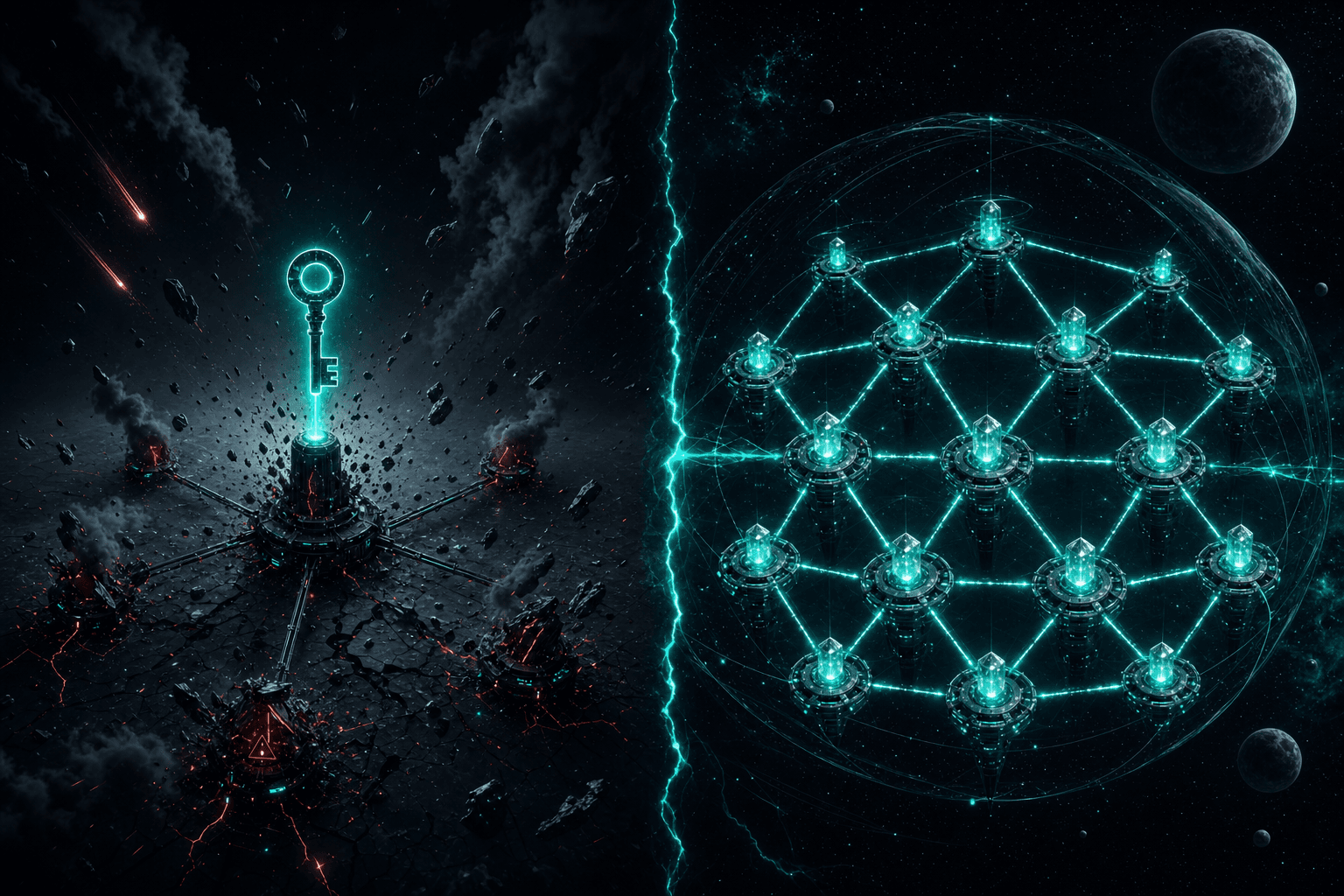
"Decentralized" is the most overused word in crypto. Every project claims it. Marketing decks lead with it. Community members cite it when defending their favorite network from criticism. But if you actually look at the validator sets, the multisig admin keys, the storage providers, and the identity systems under most "decentralized" projects, you find something more complicated than the brochure.
That's not necessarily a scandal. Building genuinely decentralized systems is hard, and honest teams make pragmatic compromises during early development. The problem is when projects never revisit those compromises, or when they actively obscure them. Let's talk about what real decentralization actually requires, and why each piece is harder than it looks.
The Validator Set Problem
A blockchain is only as decentralized as the entities validating its transactions. If 10 validators control 80% of the stake, you don't have a decentralized network. You have a cartel with a blockchain interface. The formal distributed nature of the software means nothing if the humans operating it can collude to censor transactions or reverse blocks.
According to a 2024 analysis by Messari, the top 10 validators on Ethereum control roughly 40% of staked ETH, and on many proof-of-stake networks the concentration is even higher. Solana's validator set has historically been dominated by entities with access to high-end hardware. On some "decentralized" networks, the top three validators could technically collude to halt the chain entirely.
Real decentralization at the validator layer requires accessible participation: hardware requirements that smaller operators can meet, stake requirements that don't effectively cap the validator set to a few wealthy entities, and a structure that rewards honest operation rather than scale alone. The economics of running a validator node matter directly here. If running a node requires enormous capital, participation will concentrate among those who have it.
The Bridge and Admin Key Problem
Bridges, the systems that move assets between different blockchains, represent one of the clearest examples of decentralization theater. A bridge can be called decentralized while being secured by a 3-of-5 multisig wallet controlled by five people who all know each other and work at the same company. If any three of them collude or are compromised, the bridge is stolen.
This isn't hypothetical. According to Chainalysis, bridge hacks accounted for over $2 billion in losses in 2022 alone. The Ronin bridge hack ($625 million) and the Wormhole exploit ($320 million) both involved compromised private keys held by small groups of operators. The on-chain code was correct; the off-chain key management was the vulnerability.
Admin keys are a broader version of the same problem. Many DeFi protocols have admin keys that let a small group pause contracts, change parameters, or upgrade code. This is sometimes necessary during early development, but projects that never remove admin keys or make them transparent are asking users to trust a small group of humans, not a decentralized system. The smart contract is only as decentralized as the humans who control its admin functions.
The Storage Problem
"Decentralized" NFTs are one of the clearest examples of this failure mode in action. An NFT says on the blockchain: "this token points to an image at this URL." If that URL is an HTTP link to a centralized server, the NFT artwork can be changed or deleted by whoever controls the server. The token is decentralized; the asset it references is not. Your files are effectively hostages to whoever controls the server they live on.
Even projects using IPFS (InterPlanetary File System) often pin their content with Pinata or a similar centralized pinning service. IPFS itself is content-addressed and decentralized, but if the only pin is held by a single company, the content disappears when that company stops pinning it. Genuine decentralized storage requires multiple independent pinners with economic incentives to maintain availability, like Filecoin or Arweave's permanent storage model.
Autheo's approach is to bring storage native to the network with economic incentives for operators who maintain it. When storage operators are staking and earning rewards on the same network that stores the data, their incentives align with long-term availability rather than just near-term cost minimization.
The Identity Problem
Most blockchain users interact with the ecosystem through wallets and addresses. But your on-chain identity, such as it is, is just a public key. It carries no verified information about who you are, what permissions you have, or whether you're a human or a bot. The moment you need to prove something about yourself, like your age, your credentials, or your credit history, you're back to relying on a centralized identity provider. The shift toward self-sovereign identity addresses this, and the current state of your login being someone else's asset illustrates why it matters.
For decentralization to be meaningful in a world where AI agents, applications, and human users all interact on the same network, identity needs to be on-chain and self-sovereign. Autheo's TheoID system is designed to provide exactly this: verifiable credentials that you control, that aren't managed by a corporation, and that can be used to authenticate with applications without handing your personal data to a third party.
This matters more as AI agents become active participants on blockchain networks. If you can't distinguish a human from a bot, if you can't verify that the entity you're interacting with is who they say they are, then a lot of the value proposition of decentralized finance and decentralized applications breaks down. Identity is infrastructure, not a feature.
The Post-Quantum Problem
Most blockchains today rely on elliptic curve cryptography (ECC) for signatures and key security. ECC is secure against classical computers, but not against sufficiently powerful quantum computers. Post-quantum cryptography is the effort to replace ECC with algorithms that remain secure even against quantum attacks.
NIST finalized its first post-quantum cryptography standards in 2024, selecting algorithms like CRYSTALS-Kyber and CRYSTALS-Dilithium as the new baselines. But most existing blockchain networks were designed before this work was complete, and retrofitting a live network with new cryptographic primitives is extremely difficult. It requires consensus across the entire validator set and breaks backward compatibility.
A network that claims to be built for long-term decentralization but relies on cryptographic primitives that will be vulnerable to quantum computers is making a significant bet against its own longevity. Autheo integrates post-quantum security from the architecture level, which means this isn't a future migration project. It's designed in.
What Real Decentralization Looks Like in Practice
Put it all together and real decentralization requires: a distributed validator set with accessible entry points and no single point of control; storage that's maintained by independent operators with economic incentives to keep it available; identity that's self-sovereign and on-chain; and cryptography that stays secure as the threat model evolves. The Proof of Autheo consensus mechanism was designed with all of these requirements in view.
That's a long list. And being honest about it means acknowledging that no network, including Autheo, perfectly satisfies every item on the list from day one. The compute layer, storage, and TheoID are rolling out in phases after the May 2026 mainnet launch. Building these components takes time. The goal is to build them right rather than announce them as complete before they are.
What matters is the design intent and whether the architecture allows the promise to be kept. A network built with admin keys and centralized storage can say it will decentralize later, but the architecture makes that path difficult. A network designed from the start for distributed validators, on-chain identity, and post-quantum security has a cleaner path.
Why It's Worth Caring
Decentralization isn't an aesthetic preference. It has concrete consequences for users. A decentralized network can't be shut down by a single government's demand. It can't change its terms unilaterally. It doesn't have a single point of failure that, if exploited, takes everything down at once. These properties matter for financial systems, identity systems, and data storage in ways that affect real people's ability to access their own assets and information.
The question for any project that claims decentralization isn't whether the word appears in the whitepaper. It's whether the architecture makes the promise keepable. Holding projects accountable to that question is how the space gets better.
Gear Up with Autheo
Rep the network. Official merch from the Autheo Store.

AUTHEO Bucket Hat
$25

AUTHEO Flat Bill Cap
$25

AUTHEO Women's Columbia® Fleece Vest
$55

AUTHEO Large Organic Tote Bag
$30
Theo Nova
The editorial voice of Autheo
Research-driven coverage of Layer-0 infrastructure, decentralized AI, and the integration era of Web3.
About this author →Get the Autheo Daily
Blockchain insights, AI trends, and Web3 infrastructure updates delivered to your inbox every morning.