



Decentralized Cloud Computing: How It Works and Why It Matters
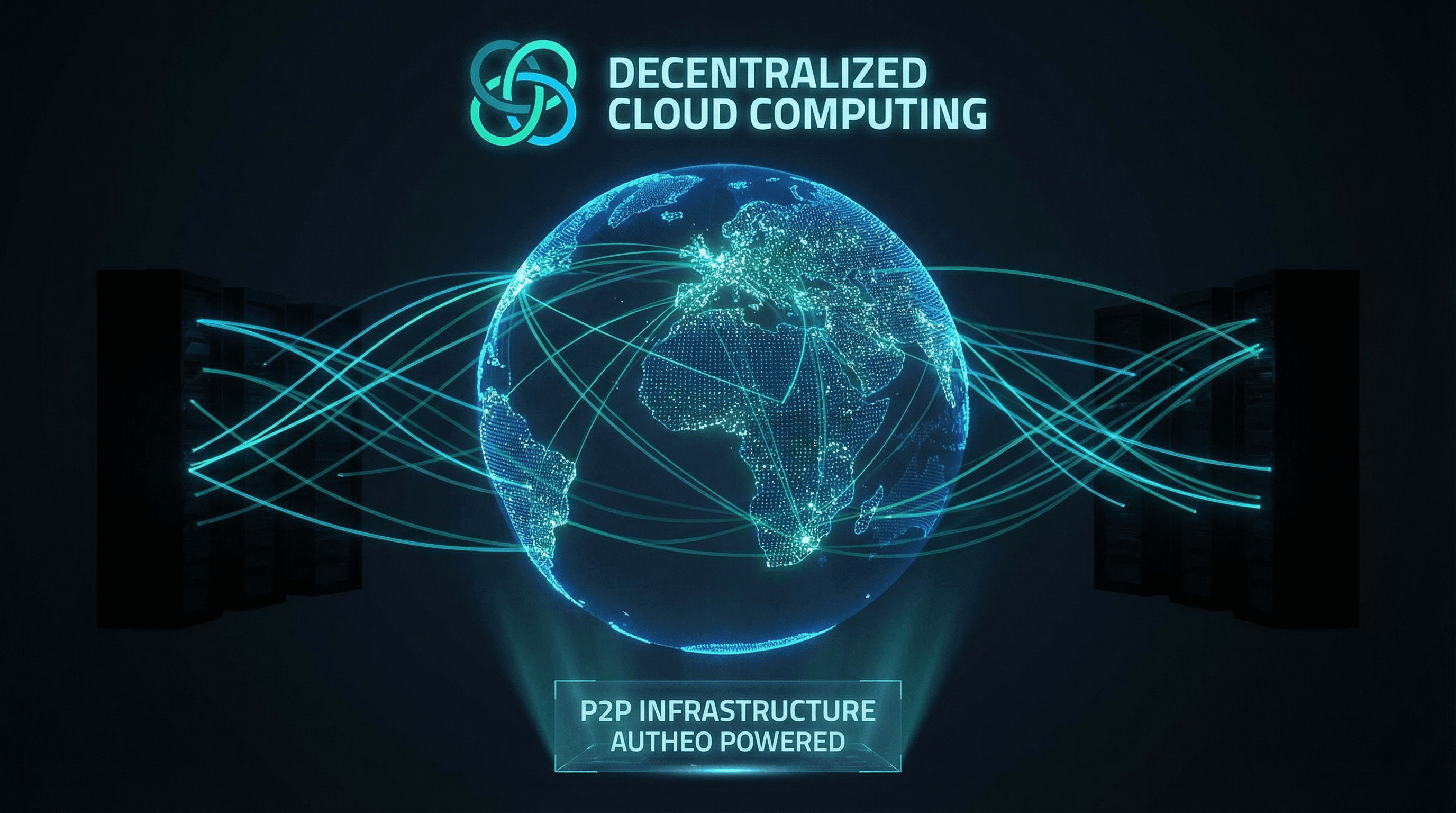
Decentralized cloud computing distributes workloads across a network of independently owned and operated nodes, coordinated by blockchain smart contracts, replacing AWS, Azure, and Google Cloud's centralized data centers with community-powered infrastructure that offers 25-85% lower total cost of ownership for certain workloads, censorship resistance, data sovereignty, and no single point of failure. By early 2026, Akash Network has seen 428% year-over-year growth in GPU compute usage, and Fluence offers virtual servers up to 85% cheaper than AWS equivalents.
Loading tweet...
The Problem With Centralized Cloud
The three major cloud providers, AWS, Azure, and Google Cloud, collectively control the compute backbone of the modern internet. This centralization creates real risks: vendor lock-in through proprietary APIs and pricing, single points of failure (AWS outages have disrupted crypto applications built on centralized infrastructure), data sovereignty conflicts (your data lives in data centers governed by whichever jurisdiction your provider operates in), and pricing opacity where costs are hard to predict and can increase without warning.
For Web3 applications specifically, centralized cloud creates a philosophical contradiction. A DeFi protocol might have immutable smart contracts on Ethereum, but if the frontend interface is hosted on AWS, Amazon can shut it down overnight, as demonstrated when AWS suspended Parler's hosting in 2021. True decentralization requires decentralized infrastructure at every layer, not just the smart contract layer.
How Decentralized Cloud Works
A decentralized cloud has three layers working together. The Physical Infrastructure Layer: community-operated nodes contribute compute (CPU/GPU), storage, and bandwidth. These can be enterprise-grade servers, home machines, or specialized edge devices. Ownership is distributed globally, mitigating both regional outage risk and regulatory jurisdiction risk.
The Blockchain Coordination Layer: smart contracts handle resource discovery and allocation, enforce service level agreements, and process payments without intermediaries. This is what transforms a collection of distributed hardware into a coordinated service, the blockchain provides the trust layer that makes it economical to use compute from providers you've never met.
The Token Economics Layer: resource providers earn tokens proportional to the quantity and quality of capacity they contribute. Consumers pay in tokens for services, creating real on-chain revenue. Staking requirements with slashing for underperformance create accountability without centralized enforcement.
Cost Comparison: Decentralized vs. Traditional Cloud
A 2023 benchmark study showed decentralized solutions offering 25-40% lower total cost of ownership for AI/ML training jobs compared to traditional hyperscalers. Fluence offers virtual servers up to 85% cheaper than AWS equivalents for certain workload profiles. Filecoin provides approximately $0.19/month for 1TB of storage compared to AWS S3's approximately $23/month, a 99% cost reduction, though with different performance characteristics.
These savings come from eliminating the corporate overhead, real estate costs, and profit margins embedded in hyperscaler pricing. When hardware is contributed by individuals and small businesses rather than a corporation with stockholders to satisfy, the economics fundamentally change. GPU compute for AI training, one of the most valuable and expensive workloads, is particularly impactful: Akash Network's GPU marketplace reports utilization above 80% heading into 2026.
Leading Decentralized Cloud Platforms
Filecoin leads decentralized storage with a massive network of miners providing petabyte-scale capacity verified by Proof-of-Spacetime. The Filecoin Onchain Cloud expansion added programmable storage and retrieval services, making it easier for enterprise developers to transition from traditional cloud. Major Web3 projects including KYVE use Filecoin to durably store blockchain data. Arweave provides permanent, pay-once storage for archival use cases.
Akash Network provides decentralized compute with Kubernetes compatibility, allowing container workloads to run on a decentralized network using the same Kubernetes tooling already familiar to DevOps teams. GPU support has made it a preferred platform for AI inference and model training. Fluence provides virtual servers with full flexibility, transparent pricing, and global reach, competing directly with VPS providers for developer workloads.
Render Network specializes in GPU compute for creative and AI workloads, connecting idle GPU owners with studios and AI developers. With a $3-5 billion market cap, Render has become one of the most significant DePIN projects, demonstrating that decentralized compute can compete with centralized providers for real production workloads.
Autheo's Integrated Decentralized Cloud
Autheo is developing decentralized compute and decentralized storage as planned native capabilities designed for future integration with the Autheo validator network, delivered through the coming Autheo Marketplace. Unlike external third-party cloud services bolted on via APIs, the architecture is designed so these capabilities will be built directly into the network, creating infrastructure that will be inherently as decentralized as the consensus mechanism it runs alongside. Note: decentralized compute and decentralized storage have not yet been released; they are part of Autheo's roadmap.
This architecture is designed so that applications built on Autheo will be able to leverage decentralized cloud natively, without switching cloud providers or managing multiple service relationships. A smart contract that needs to store outputs will be able to use decentralized storage through the coming Autheo Marketplace, via the same SDK that handles contract deployment. An AI application that needs inference compute will be able to use decentralized compute through THEO AI's native integration. This seamless developer experience is what Autheo envisions with its 'Web3 Operating System' concept, a unified platform rather than a collection of independently integrated services.
The Hybrid Reality
Practical deployments in 2026 are mostly hybrid. Traditional cloud offers better performance and ease of use for latency-sensitive workloads; decentralized cloud offers better cost, sovereignty, and censorship resistance for workloads where those properties matter. Many dApps host their frontend on traditional cloud for performance while using decentralized storage for user data and smart contract state. As decentralized cloud performance matures, the hybrid ratio will shift toward more fully decentralized architectures. Gartner projects that 90% of organizations will operate hybrid cloud by 2027.
Key Takeaways
- Decentralized cloud distributes workloads across community-owned nodes coordinated by blockchain, replacing centralized AWS/Azure/GCP data centers.
- Cost savings: 25-40% lower TCO for AI/ML workloads, up to 85% cheaper virtual servers (Fluence vs AWS), 99% cheaper storage in some comparisons.
- Akash Network: 428% YoY GPU compute growth, 80%+ utilization heading into 2026.
- Leading platforms: Filecoin (storage), Akash (Kubernetes compute), Fluence (virtual servers), Render (GPU/AI compute).
- Autheo is building decentralized compute and decentralized storage as planned native extensions to its validator network, delivered through the coming Autheo Marketplace and designed to let applications access decentralized cloud through the same SDK as smart contract development (not yet released; planned for a future phase).
- 2026 reality is hybrid: traditional cloud for latency-sensitive workloads, decentralized cloud for cost, sovereignty, and censorship resistance.
Explore Autheo's vision for integrated decentralized cloud at autheo.com. The current node sale is for validator nodes that secure consensus and earn THEO emissions, with decentralized compute and decentralized storage planned as future capabilities of the network through the coming Autheo Marketplace.
Gear Up with Autheo
Rep the network. Official merch from the Autheo Store.

AUTHEO Bucket Hat
$25

AUTHEO Flat Bill Cap
$25

AUTHEO Women's Columbia® Fleece Vest
$55

AUTHEO Large Organic Tote Bag
$30
Theo Nova
The editorial voice of Autheo
Research-driven coverage of Layer-0 infrastructure, decentralized AI, and the integration era of Web3.
About this author →Get the Autheo Daily
Blockchain insights, AI trends, and Web3 infrastructure updates delivered to your inbox every morning.