



THEO Token in 2026: Six Utility Drivers and How They Create Network Demand
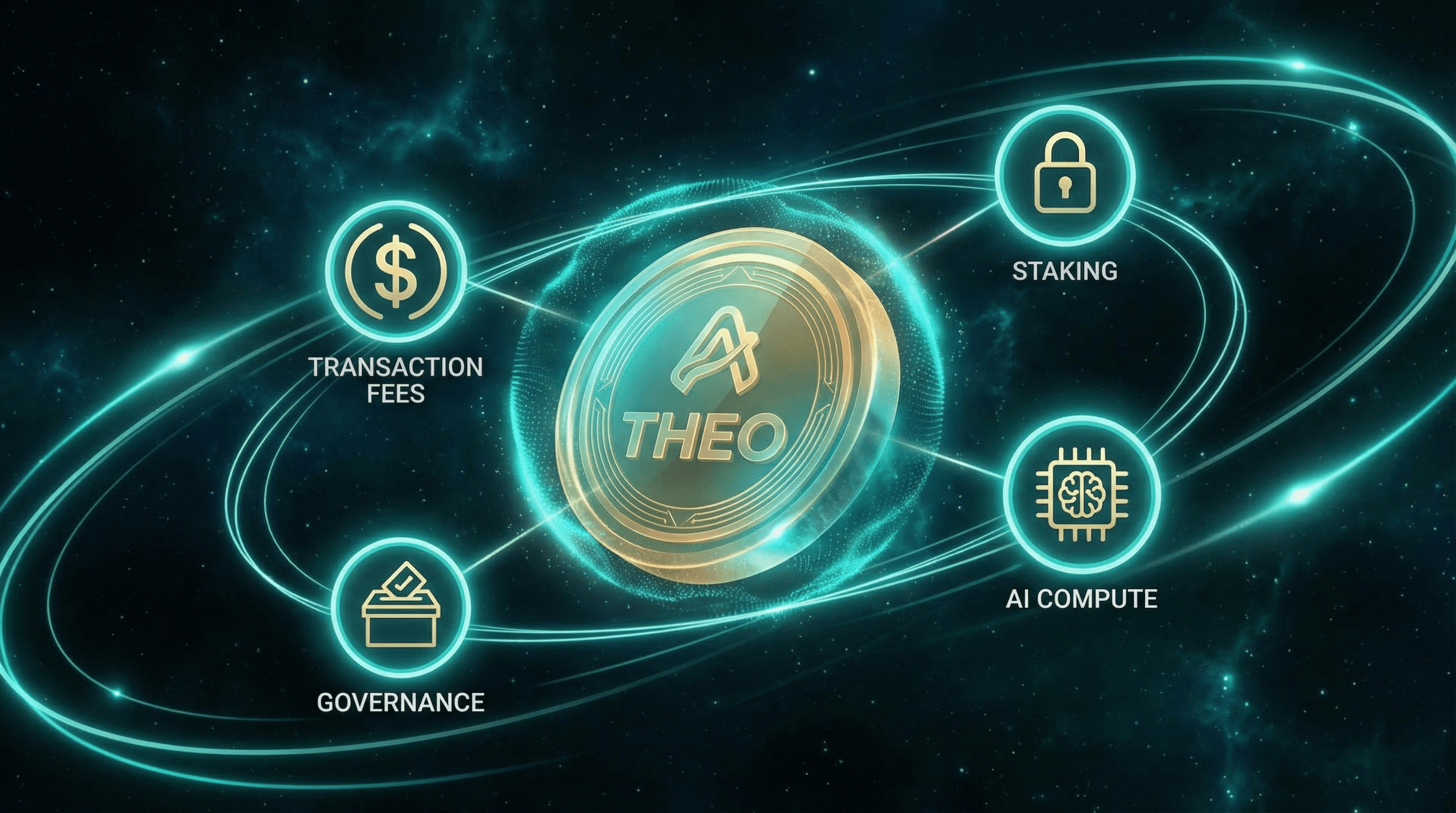
Most token projects promise utility. Few actually deliver mechanisms that create durable, recurring demand. THEO, the native token of the Autheo network, is designed around six distinct utility vectors, each of which pulls tokens from the circulating supply and puts them to work inside Autheo's infrastructure stack, with staking and transaction fees live today and compute, storage, AI inference, and identity rolling out over the coming months. If you're trying to understand what THEO actually does inside the network, those vectors are where the real picture begins.
This guide walks through each utility driver with enough specificity to understand the demand mechanics, not just the marketing narrative.
Why Utility Design Matters
THEO is a utility token, full stop. It's not a governance token, it carries no voting rights over protocol parameters, and Autheo is not a DAO. Autheo operates as a centralized commercial entity with clear corporate structure, professional management, and the Autheo Foundation serving as a separate, board-governed non-profit that manages community programs and open-source contributions. That distinction matters: governance tokens derive value from a claim on protocol decisions, which is legally murky and economically uncertain. Utility tokens derive value from actual consumption demand within a functioning network.
Autheo has been incubated by Launch Legends over 4.5+ years, with more than 100 co-founders across 25+ countries contributing to the protocol's design. That depth of institutional development means the utility mechanisms described below aren't aspirational; they're built into the architecture.
The Six THEO Utility Drivers
1. Staking: Structural Scarcity Through 399 Validator Positions
Staking on Autheo is not a simple lock-and-earn system. The validator set is capped at exactly 399 positions, divided into three tiers: Core (1%), Prime (10%), and Sovereign (100%). This hard cap creates structural scarcity. When 399 slots are filled, any new operator seeking a position must either wait for a slot to open or acquire THEO in the secondary market at whatever price the market sets. Learn more about the Proof of Autheo consensus architecture.
Validator rewards are performance-weighted, meaning operators who contribute more reliably to network uptime and throughput earn proportionally more THEO. That creates a competitive market for validator slots and reinforces long-term staking behavior. Tokens locked in validator positions are effectively removed from liquid supply for the duration of the stake. The DePIN incentive design here reflects best practices from the broader infrastructure token space: tie rewards to verifiable performance, not just capital commitment.
Fixed-slot validator systems have historically produced consistent demand pressure on tokens as networks scale. Ethereum's early validator economics demonstrated this pattern clearly, with validator queues creating sustained buying demand during network growth phases.
2. Compute: How Decentralized Execution Is Designed to Work
Autheo's decentralized compute layer, delivered through the coming Autheo Marketplace, is designed to be the execution layer for smart contracts, dApps, and the increasingly important category of autonomous AI agents operating on-chain, once decentralized compute rolls out to mainnet over the coming months. Every compute operation consumed through the coming Autheo Marketplace will require THEO. As transaction volumes grow and more applications deploy, compute demand is expected to scale with them.
The coming Autheo Marketplace is designed to serve both human-initiated transactions and machine-to-machine payments, which is a fast-growing segment. Once live, agentic AI systems that need to pay for execution resources, read contract state, or trigger on-chain actions will route through the coming Autheo Marketplace and consume THEO in the process. This is expected to create recurring, automated, programmatic demand that doesn't depend on any single user's behavior.
3. Storage: The Coming Autheo Marketplace Creates a Persistent Data Economy
Decentralized storage, delivered through the coming Autheo Marketplace, is Autheo's storage layer, rolling out to mainnet over the coming months. Once live, developers and enterprises that need persistent, verifiable, on-chain data storage will pay in THEO. Unlike compute, which is transactional, storage is expected to create a subscription-like demand pattern: data stored through the coming Autheo Marketplace will generate recurring THEO consumption as long as the data persists.
This is particularly relevant for real-world asset tokenization use cases. As institutions tokenize financial instruments, real estate, and other assets, they need durable, auditable storage for asset records. The RWA tokenization market has already surpassed $30 billion, and the storage demands of tokenized assets are expected to compound over time as more records accumulate. Once live, decentralized storage through the coming Autheo Marketplace is designed to position THEO as the settlement currency for that storage demand.
4. AI Inference: A New THEO Consumption Category
AI inference is a planned utility layer within the Autheo protocol, rolling out to mainnet over the coming months. Once live, users and developers who access AI inference capabilities, whether for on-chain analysis, automated contract interactions, or AI agent identity verification, will consume THEO in the process. This is expected to create a category of AI-driven token demand that's structurally new compared to earlier blockchain generations. Separately, the THEO AI developer assistant, a coding and scaffolding tool planned for DevHub, is designed to help builders write and deploy smart contracts faster once it's live.
Consider what this means at scale: if AI agents become primary users of blockchain infrastructure (as many forecasters now expect), the inference layer becomes a high-frequency consumption channel. Each AI query, each automated decision, each on-chain action taken by a model routes through THEO. The token becomes fuel for machine intelligence, not just human transactions.
According to Grand View Research, the global AI infrastructure market is projected to reach $422.37 billion by 2030, growing at a compound annual rate of 28.9%. Protocols that capture even a fraction of that inference demand in on-chain fees will see substantial token consumption volumes.
5. Transaction Fees: The Baseline Demand Floor
Transaction fees are the most fundamental utility driver. Every operation on the Autheo network requires THEO to pay for execution. This isn't optional or replaceable with another asset; it's hardcoded into the protocol. Stablecoin settlement flows, DeFi protocols, NFT marketplaces, enterprise applications, and every other on-chain activity generates fee demand. As network throughput increases, fee demand scales proportionally.
Transaction fee demand has a compounding quality: more users attract more developers, more developers build more applications, more applications generate more transactions. The token's fee consumption grows with the ecosystem. Ethereum generated over $2.3 billion in transaction fees in 2023 alone, illustrating what fee-based utility looks like at scale when a network achieves meaningful adoption.
6. Identity: TheoID and the Verified Credential Economy
TheoID is Autheo's on-chain identity layer, rolling out to mainnet over the coming months. Once live, it will allow users, enterprises, and AI agents to establish verifiable, privacy-preserving digital identities that can be used across applications within the network. Identity provisioning, credential issuance, and verification operations will consume THEO. Combined with Autheo's planned post-quantum security roadmap using NIST-standardized algorithms including Kyber, Dilithium, and Falcon, TheoID is being built for long-term durability against emerging cryptographic threats. That post-quantum work is not yet threaded into the live system.
Identity is a sleeper utility driver. Digital identity verification is required for regulatory compliance in financial services, healthcare, government, and increasingly in AI-agent authorization. As compliance requirements tighten globally, on-chain verified identity is expected to become a necessity rather than a feature. Once TheoID is live, every identity operation on it is expected to create token demand, and as Autheo onboards enterprise clients, identity-related consumption could become one of the largest demand vectors in the ecosystem.
The self-sovereign identity market is forecast to grow from $1.1 billion in 2024 to over $19 billion by 2032, driven by demand for user-controlled, privacy-preserving credentials across both consumer and enterprise contexts.
Emission Schedule: How Supply Enters Circulation
THEO follows a 7-year linear emission schedule, releasing 7.5% of total supply per year. That translates to approximately 525 million THEO annually entering circulation through validator rewards and ecosystem incentives. Linear schedules are predictable. Anyone can model supply-side pressure with reasonable precision because the issuance rate doesn't change based on market conditions or protocol votes.
The design question is whether demand growth can absorb supply emissions. With six utility vectors each capable of pulling significant THEO from circulation, the demand side of the equation is substantially more complex than single-purpose utility tokens where everything rides on one mechanism. Six concurrent demand drivers absorbing supply simultaneously is what makes the emission schedule workable at 525M THEO per year.
Performance-weighted validator rewards introduce an additional dynamic: tokens flow preferentially toward high-performing operators rather than being distributed uniformly. This concentrates staking among serious, long-term participants rather than passive holders. Over time, that tends to reduce circulating supply more effectively than uniform distribution models.
Security and Compliance: The Infrastructure Behind the Token
Institutional adoption of blockchain infrastructure increasingly depends on security credibility. Autheo has been audited by two leading blockchain security firms. Halborn reviewed the testnet architecture, covering smart contract code, validator infrastructure, and network design for vulnerabilities. For the mainnet, Autheo engaged CertiK, one of the most widely recognized audit firms in the industry with a track record across hundreds of major protocols. Both audits address smart contract risk, one of the primary risk factors in any production blockchain deployment. Combined with regulatory compliance positioning under the Clarity Act framework, Autheo is designed to operate within, not around, the emerging regulatory structure for digital assets.
The post-quantum security architecture deserves specific mention. Kyber handles key encapsulation, Dilithium and Falcon provide digital signatures, all three standardized by NIST in 2024. Most existing blockchain networks are vulnerable to quantum computing attacks on their cryptographic foundations. Autheo is built to be quantum-resistant from the start. As quantum computing capabilities advance, this isn't a theoretical advantage; it's a genuine competitive moat that becomes more valuable over time.
How THEO Compares to Single-Utility Tokens
Many infrastructure tokens are built around a single utility mechanism. Storage tokens need storage demand. Compute tokens need computation demand. Identity tokens need identity adoption. When that single mechanism underperforms, the entire token thesis breaks. The fragmentation problem across L1 architectures has often stemmed from narrow utility designs that can't sustain demand across market cycles.
THEO's six-vector design creates diversification at the token level. If AI inference demand is slower to develop than compute demand, staking and transaction fees still absorb supply. If identity adoption accelerates ahead of schedule, that creates additional demand pressure that wasn't in the base case. The token's demand profile is genuinely diversified across infrastructure categories that are each independently valuable and growing.
All tokens carry market risk, and early-stage infrastructure tokens carry significant execution risk. But the design philosophy, six concurrent utility mechanisms consuming a token with hard-capped validator slots and a predictable emission curve, is structurally more robust than single-use alternatives.
The Autheo Foundation and Long-Term Protocol Health
The Autheo Foundation operates as an independent non-profit with board governance, separate from the commercial entity. Its mandate covers developer grants, open-source contributions, academic research partnerships, and community programs. This separation is meaningful: it means the commercial operation maintains clear profit motives and business focus while the Foundation handles ecosystem stewardship without creating governance ambiguity around the token.
Launch Legends, the incubator behind Autheo, brings more than 100 co-founders across 25+ countries to the project. That global contributor base has shaped a protocol designed for international deployment from the start rather than a single-market MVP trying to expand afterward. For a platform targeting enterprise identity, cross-border settlement, and AI infrastructure, that global foundation is operationally relevant, not just a marketing stat.
Regulatory Positioning in 2026
The regulatory environment for digital assets has clarified substantially in 2026. The SEC and CFTC token taxonomy framework has created clearer lanes for utility tokens like THEO. Because THEO doesn't confer governance rights or profit-sharing entitlements, its classification as a utility token is substantially cleaner than tokens with hybrid governance-utility designs. That regulatory clarity benefits both protocol operations and the broader ecosystem of builders deploying on Autheo.
Validator staking rewards have been designed with compliance in mind. The 2026 staking reward compliance framework distinguishes between yield-bearing instruments that resemble securities and performance-based infrastructure rewards that don't. THEO's validator reward design falls into the latter category: rewards are earned through active infrastructure contribution, not passive capital deployment.
Key Questions About THEO's Design
Understanding THEO comes down to a few core questions about how the protocol is designed and where it stands today:
Will the network attract enough usage to generate meaningful demand? Six utility vectors across compute, storage, AI inference, identity, staking, and transaction fees each contribute independently. The network doesn't need all six to fire simultaneously to create demand pressure. Two or three operating well at launch creates a foundation for the others.
How does the supply schedule work? At 525 million THEO annually over 7 years, the emission schedule is predictable and linear. Fixed validator slots and performance-weighted rewards favor long-term participation over short-term extraction.
Is the infrastructure actually built? Compute, storage, TheoID, and THEO AI are in development after 4.5+ years of incubation through Launch Legends and are rolling out to mainnet over the coming months. Staking and transaction fees are live today; the remaining components are not live yet. The mainnet has been audited by both Halborn and CertiK. This is a phased rollout, not a claim that every planned utility is already available.
What is the regulatory risk profile? Pure utility token, no governance rights, audited by Halborn and CertiK, Clarity Act compliant design. The legal classification is cleaner than most tokens in the infrastructure category.
If you're ready to move beyond token mechanics into the technical details, the guide to deploying your first smart contract on Autheo is a practical next step that shows what building on the network actually looks like. The real test of any infrastructure token is whether developers want to build on it. The early signals from the Autheo developer community suggest they do.
THEO isn't a bet on a single feature. It's a full infrastructure stack, one that's taken years to build, has been audited by two independent security firms, and sits inside a regulatory framework that's becoming clearer every quarter. That's a different category than most tokens competing for the same attention in 2026.
Disclosure: This post is for informational purposes only and does not constitute financial or investment advice. Cryptocurrency investments carry significant risk including loss of principal. Always conduct your own due diligence before making investment decisions.
Gear Up with Autheo
Rep the network. Official merch from the Autheo Store.


Theo Nova
The editorial voice of Autheo
Research-driven coverage of Layer-0 infrastructure, decentralized AI, and the integration era of Web3.
About this author →Get the Autheo Daily
Blockchain insights, AI trends, and Web3 infrastructure updates delivered to your inbox every morning.