



What Does Post-Quantum Security Mean for Ordinary People?
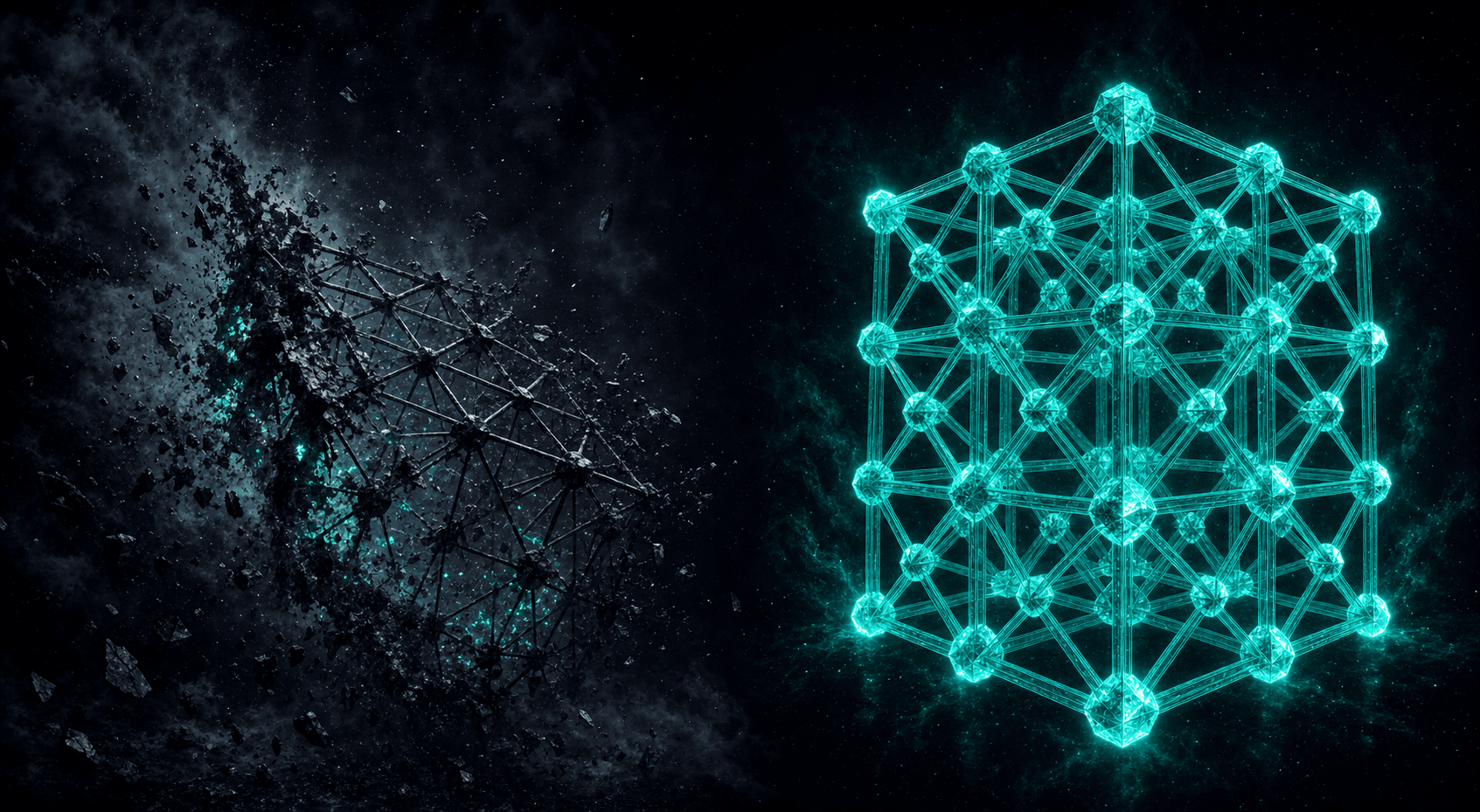
If someone told you that the security protecting your bank account was fundamentally breakable by a computer that doesn't fully exist yet, you'd probably want to know when it was going to exist. That's basically where we are with quantum computing and cryptography. The threat isn't science fiction, but the timeline is uncertain enough that most people haven't started paying attention. That's exactly why the time to act is now, not when the machines arrive.
Autheo built post-quantum security in from day one. Specifically, it uses Kyber and Dilithium, two of the algorithms selected by the National Institute of Standards and Technology (NIST) in its finalized 2024 post-quantum cryptography standards. To understand why that matters, you need to understand what quantum computing actually threatens, and why the window to act is shorter than it looks.
How Encryption Works Today
Most encryption on the internet today relies on a mathematical problem that's easy to perform in one direction but extraordinarily difficult to reverse. The classic example is multiplying two large prime numbers together. That multiplication takes a fraction of a second. Working backward to figure out which two primes were multiplied, starting only from the result, takes the most powerful computers on Earth millions of years.
That difficulty is the foundation of RSA encryption, which protects a huge portion of internet traffic. The TLS protocol securing your connection to your bank uses variants of this math. So does most of the cryptography underlying current blockchain networks. It works because classical computers simply can't crack it fast enough to be useful to an attacker.
Quantum computers change the math. An algorithm called Shor's algorithm, designed specifically for quantum hardware, can factor large numbers exponentially faster than any classical computer. A sufficiently powerful quantum computer running Shor's algorithm could break RSA encryption in hours or days instead of millions of years. The asymmetry that protects us today collapses.
When Does "Sufficiently Powerful" Arrive?
This is the question that makes people procrastinate. Quantum computers exist today, but they're not yet powerful enough to break RSA at the key sizes used in real security systems. IBM, Google, and others have built machines with hundreds to thousands of qubits, but the quality of those qubits, specifically their error rates, remains a significant limiting factor. Most experts estimate that cryptographically relevant quantum computers, the kind that could crack today's encryption at scale, are somewhere between 10 and 20 years away.
That sounds like a comfortable buffer. It isn't. Here's why. Adversaries are already collecting encrypted data today under what security researchers call a "harvest now, decrypt later" strategy. They capture encrypted communications or transactions right now, store them, and plan to decrypt them once quantum computers are capable enough. The 2022 National Security Memorandum from the White House explicitly flagged this threat as a present-day risk, not a future one.
For blockchain specifically, the problem is structural. Transactions are permanently recorded on-chain. The addresses and public keys associated with those transactions are visible to anyone. If those keys are encrypted with algorithms that quantum computers can eventually break, then every wallet that has ever exposed its public key on-chain could theoretically be compromised retroactively once the hardware matures. That's a category of risk most crypto projects simply haven't addressed.
What NIST Did in 2024
NIST spent six years running an open global competition to identify cryptographic algorithms that can withstand quantum attacks. In 2024, they finalized three primary standards. CRYSTALS-Kyber handles key encapsulation: the process of securely exchanging encryption keys between parties. CRYSTALS-Dilithium handles digital signatures: verifying that a message or transaction came from who it claims to come from. FALCON is a more compact signature scheme for environments where space matters.
These algorithms are based on mathematical problems that quantum computers are not believed to be able to solve efficiently, even using known quantum algorithms. The math shifts from number factoring to lattice-based problems, which have a fundamentally different structure that resists Shor's algorithm and its cousins.
NIST's endorsement is significant because it represents the judgment of hundreds of cryptographers working for years across dozens of countries. These aren't experimental algorithms. They're the new baseline for government, finance, and infrastructure security.
Most Blockchains Haven't Upgraded
The broader picture of post-quantum cryptography and blockchain is genuinely concerning. Bitcoin and Ethereum both rely on elliptic curve cryptography (ECC) for their digital signatures. ECC is also broken by Shor's algorithm. Ethereum has discussed post-quantum upgrades but has not implemented them at the protocol level as of this writing. Bitcoin's upgrade path is even more complicated, given its conservative governance structure.
Retrofitting post-quantum security into an existing blockchain is not a simple software update. It requires changing the fundamental cryptographic primitives the network uses for signing transactions, changing key formats, and potentially migrating millions of existing wallets. For networks with billions of dollars in value and thousands of stakeholders who must reach consensus on changes, this is an extraordinarily difficult coordination problem.
That's why building it in from day one matters so much. Autheo didn't have to retrofit anything. Kyber and Dilithium are native to the network's cryptographic stack. Every transaction, every signature, every key exchange on Autheo is post-quantum secure by default.
What This Means for Someone Who Just Wants Their Assets Safe
Let's step back from the cryptography and ask a plain question: what does any of this mean for someone who holds digital assets and wants them to still be secure in 2035?
On a classical blockchain without post-quantum security, your wallet's security depends on the difficulty of reversing elliptic curve math. That difficulty is real today. But if you're planning to hold assets for a decade or more, you're betting that the quantum computing timeline stays slow. That might be a safe bet. It might not be.
On Autheo, the security doesn't depend on that bet. Kyber and Dilithium don't become less secure if quantum computing progresses faster than expected. And given that your login is already someone else's asset on most platforms, the question of who controls your cryptographic identity and how securely it's protected becomes more important, not less.
The U.S. Cybersecurity and Infrastructure Security Agency (CISA) recommends that organizations begin their post-quantum migration planning now, specifically because the lead time for large systems is measured in years. For infrastructure that's designed to run for decades, "start planning now" translates to "build it right from the start."
The Connection to Digital Identity
Post-quantum security and self-sovereign identity are deeply connected. Your digital identity is, at its foundation, a cryptographic key. If that key can be broken, your identity can be impersonated. A self-sovereign identity system that runs on quantum-vulnerable cryptography isn't actually giving you control; it's giving you an illusion of control that a future attack could dissolve.
Autheo's TheoID identity layer is secured with the same post-quantum algorithms as the rest of the network. That alignment matters. You can't have a quantum-resistant transaction layer sitting on top of a quantum-vulnerable identity layer; the weakest link determines the system's security. Building it consistently from the ground up is the only approach that actually holds.
For a full overview of everything the network does, the complete guide to Autheo covers all five layers and how they work together. Post-quantum security is woven through all of them.
Post-quantum security is one piece of a larger architecture. If you want to understand how it fits with everything else Autheo is building, the plain English guide to Autheo covers the full picture. The short version: post-quantum cryptography isn't a feature Autheo added. It's a design principle baked into every layer of the network. When quantum computers mature, the math protecting Autheo's network won't break. For an infrastructure project built to last decades, that's not optional. It's the minimum standard.
Gear Up with Autheo
Rep the network. Official merch from the Autheo Store.

AUTHEO Bucket Hat
$25

AUTHEO Gradient Everyday Carry Tote Bag
$30.50

AUTHEO Large Organic Tote Bag
$30

AUTHEO Hoodie
$50
Theo Nova
The editorial voice of Autheo
Research-driven coverage of Layer-0 infrastructure, decentralized AI, and the integration era of Web3.
About this author →Get the Autheo Daily
Blockchain insights, AI trends, and Web3 infrastructure updates delivered to your inbox every morning.