



What Is the THEO Token? Utility, Tokenomics, and Use Cases
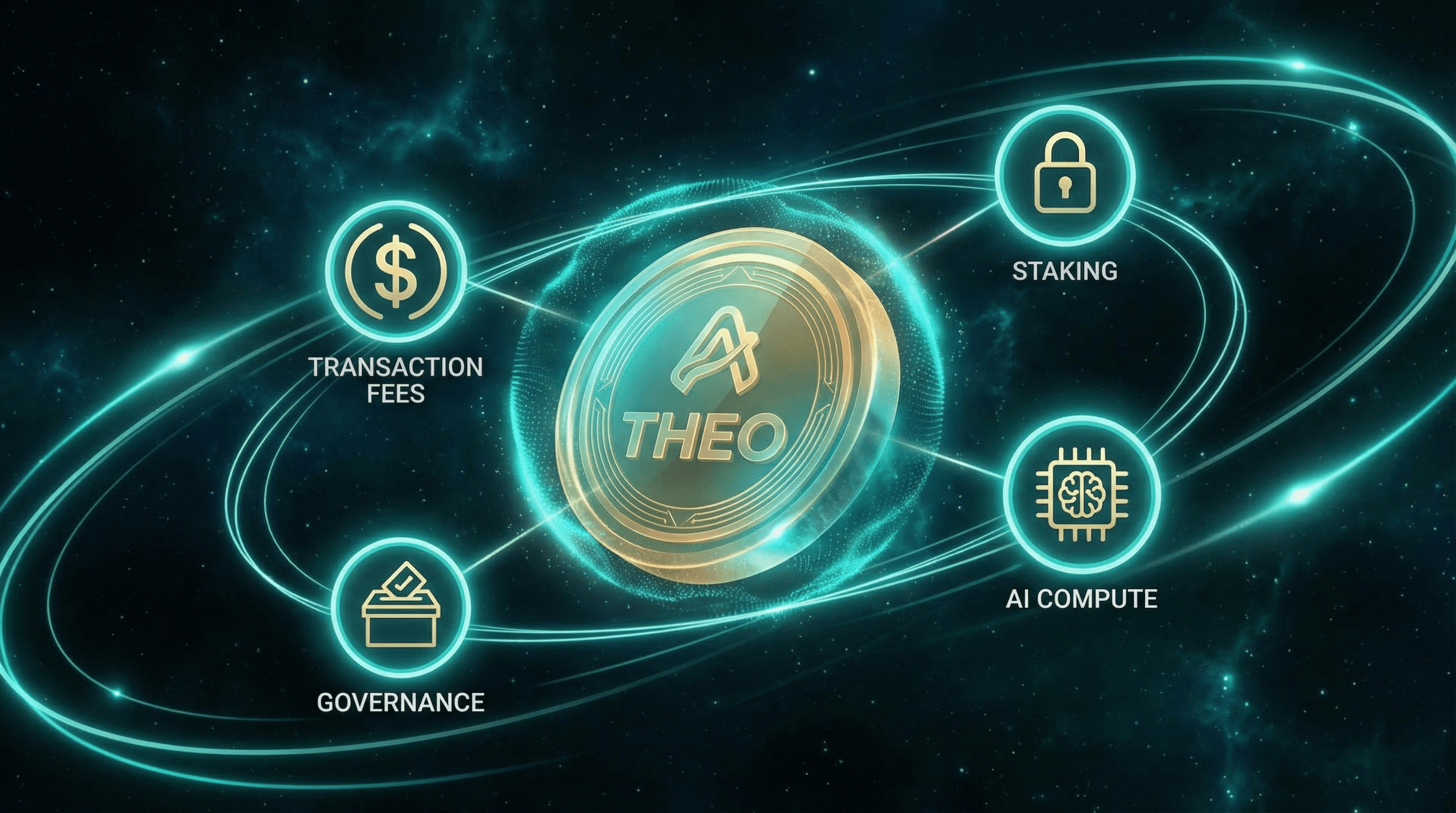
The THEO token is the native utility token of the Autheo ecosystem, serving as the economic coordination mechanism for an entire Layer-0 Operating System. THEO is used today to pay transaction fees and stake to secure the network, with accessing compute and storage resources and executing AI inference tasks rolling out over the coming months, and it rewards the validators and contributors who secure and expand the network. Unlike tokens that primarily serve speculative purposes, THEO's utility is multi-dimensional, touching every layer of Autheo's integrated infrastructure. Learn more about the Proof of Autheo consensus architecture.
Loading tweet...
What Does THEO Actually Do?
THEO is designed to serve four primary use cases in the Autheo ecosystem: Transaction Fees (paying for smart contract execution and data operations on Autheo's Layer-1, live today), Compute Access (purchasing decentralized compute cycles through the coming Autheo Marketplace), Storage Access (paying for decentralized storage through the coming Autheo Marketplace), and AI Inference (paying for AI inference and agent execution). Transaction fees and staking are live on mainnet now; compute access, storage access, and AI inference are rolling out over the coming months.
This multi-utility design creates what economists call diverse demand drivers. A DeFi protocol paying transaction fees, an enterprise using decentralized storage, and an AI developer purchasing inference credits all create demand for THEO, from different activity profiles with different price sensitivities. This diversity is designed to create more stable, durable demand than tokens whose value depends on a single use case.
Network Economics: Supply Design
THEO has a fixed maximum supply, unlike inflation-based models where the token supply expands indefinitely, Autheo's fixed cap creates known scarcity. The 7.5% of total supply allocated to validator nodes is released according to a structured emission schedule tied to network participation, not arbitrary time-based inflation. This supply-controlled model is designed to align validator incentives with long-term network health.
Validators stake THEO to participate in consensus, securing the network through economic collateral. Slashing conditions, where validators lose a portion of their staked THEO for misbehavior, create negative incentives for dishonest participation. The staking model thus creates two-sided demand: validators must acquire and lock THEO to participate, while users must acquire THEO to access network services.
Autheo Foundation and Network Stewardship
Autheo is a centralized commercial entity operating decentralized blockchain infrastructure. The Autheo Foundation is a non-profit governed by a board of directors that oversees network development, ecosystem grants, and long-term strategic direction. THEO is a utility token, it is not a governance token and does not confer voting rights over organizational decisions.
The Autheo Foundation intends to facilitate community feedback channels as the network matures, giving validators, developers, and ecosystem participants a voice in shaping the platform's direction. However, Autheo does not operate on-chain governance for organizational decisions, and is not committing to governance rights for token holders at this time. Network stewardship remains with the Foundation's board, ensuring accountable, long-term decision-making.
Validator Node Tiers and THEO Emissions
Autheo's current validator node sale offers three tiers, Core, Prime, and Sovereign, that differ in price and emission rate. All three tiers perform the same validator function: securing consensus and earning THEO emissions. Higher tiers carry higher emission allocations, reflecting a greater share of the 7.5% total supply reserved for validator nodes. Compute, storage, AI inference, and other multi-service capabilities are part of Autheo's planned roadmap and are not part of what any tier delivers today. All tiers participate in the 7.5% total supply allocation to validator nodes, distributed over time based on network participation and performance metrics.
The node sale raised over $266,000 with early allocations selling out, demonstrating strong demand from infrastructure operators who want to participate in the network from its earliest phase. This early node operator community becomes the foundational validator set for the Living Internet, operators who are both economically aligned through THEO emissions and operationally committed through running live infrastructure. As the network's roadmap progresses, additional service capabilities are planned to expand what node operators can contribute and earn.
THEO vs Native Tokens of Competing Platforms
Comparing THEO's utility model to other Layer-0 tokens is instructive. ATOM (Cosmos) is primarily used for staking on the Cosmos Hub and IBC transaction fees, with governance rights. DOT (Polkadot) is used for parachain bonding in auctions, staking, and governance. Both are excellent at what they do but are fundamentally interoperability-focused tokens.
THEO's model goes further: it is designed to serve simultaneously as a staking token, a compute credit, a storage credit, and an AI inference credit. This breadth reflects Autheo's OS philosophy, the token is the economic medium for an entire operating system, not just a blockchain protocol. As Autheo's compute, storage, and AI services are activated in future phases and attract enterprise users, THEO demand is intended to be driven by real operational use, not just speculative participation in interoperability.
Long-Term Sustainability
Autheo's tokenomics are designed for long-term sustainability with three principles: a fixed maximum supply to prevent inflation from eroding value; activity-driven demand where THEO is consumed by real network operations (every smart contract call today, and every AI inference and storage transaction once those layers roll out); and aligned incentives between validators (who earn THEO for services) and developers (who build applications that consume THEO).
Over time, network activity, driven by enterprise adoption, DeFi applications, AI inference demand, and developer growth, is intended to replace emission-based rewards as the primary income source for validators. This transitions the ecosystem from a bootstrap phase (rewards-driven) to a sustainable phase (fee-driven), mirroring how successful Layer-1 networks have evolved.
Key Takeaways
- THEO token is designed to serve four primary use cases: transaction fees, compute access, storage access, and AI inference, creating multi-dimensional demand across the ecosystem as each capability is activated. Transaction fees and staking are live today; the rest roll out over the coming months.
- Fixed maximum supply with 7.5% allocated to validators through a structured emission schedule tied to network participation.
- The Autheo Foundation, a non-profit governed by a board, oversees network development and ecosystem direction. THEO is a utility token, not a governance token.
- Three validator node tiers (Core, Prime, Sovereign) differ by price and emission rate, all perform the same consensus validator function, with higher tiers receiving higher THEO emission allocations.
- THEO's multi-service utility model differentiates it from single-purpose interoperability tokens like ATOM and DOT.
- Long-term tokenomics shift from emission-based to fee-based sustainability as network activity grows, the sustainable model for Layer-0 infrastructure.
Learn more about THEO token economics and how to participate in the Autheo ecosystem at autheo.com. Developer resources are available at docs.autheo.com.
Gear Up with Autheo
Rep the network. Official merch from the Autheo Store.

AUTHEO Bucket Hat
$25

AUTHEO Flat Bill Cap
$25

AUTHEO Women's Columbia® Fleece Vest
$55

AUTHEO Large Organic Tote Bag
$30
Theo Nova
The editorial voice of Autheo
Research-driven coverage of Layer-0 infrastructure, decentralized AI, and the integration era of Web3.
About this author →Get the Autheo Daily
Blockchain insights, AI trends, and Web3 infrastructure updates delivered to your inbox every morning.