



Building Onchain AI Agents That Actually Work: Architecture, Wallets, and Failure Modes
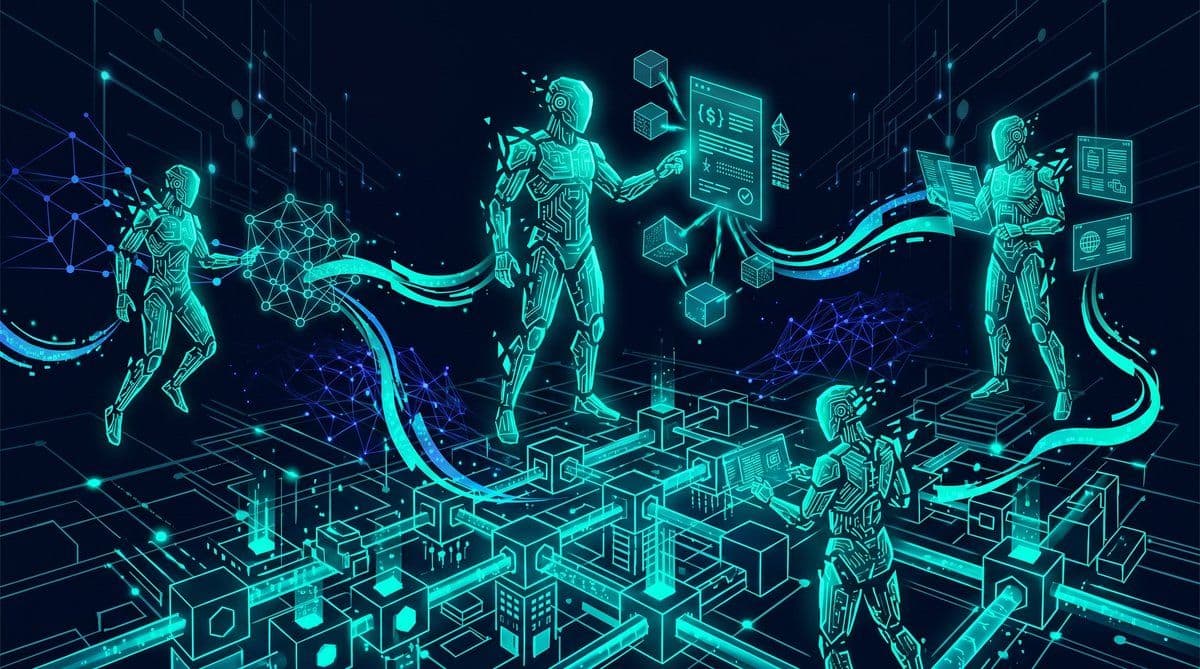
Onchain AI agents are software systems that can hold assets, make decisions, and execute transactions autonomously on a blockchain. Building one that actually works in production requires a different mental model than building a chatbot or a traditional dapp.
This guide walks through the architecture patterns, wallet design, execution strategies, and failure modes that matter when you are building AI agents that operate with real value on public chains.
What makes an onchain agent different from a bot
Bots have been running onchain for years: MEV bots, arbitrage bots, liquidation bots. They follow deterministic logic, react to specific triggers, and execute predefined transactions.
Onchain AI agents are different in three important ways:
They make non-deterministic decisions. An agent might choose which yield farm to enter, how much to allocate, or when to exit based on a language model or reinforcement learning policy. The output is probabilistic, not hardcoded.
They manage broader scopes. A bot typically handles one task. An agent might manage a portfolio, negotiate with other agents, pay for compute, and adjust its strategy over time.
They persist across sessions. Agents maintain state, learn from outcomes, and carry context forward. A restarted bot picks up where its code tells it to. A restarted agent needs to reconstruct its reasoning context.
This distinction matters because the architecture you need for non-deterministic, stateful, multi-action systems is fundamentally different from a cron job with a private key.
Architecture patterns for production agents
Most production onchain agents follow a variation of the observe-reason-act loop. The specifics vary, but the core pattern looks like this:
The observation layer
Your agent needs to read chain state reliably. That means:
- RPC connections with failover. Never depend on a single provider. Use at least two independent RPC endpoints with automatic switching on latency spikes or errors.
- Event indexing. For complex agents, raw RPC calls are too slow. Use a local indexer or a service like Goldsky, Envio, or The Graph to pre-process events into queryable state.
- Off-chain data feeds. Most interesting agent decisions require data beyond the chain: price feeds, social signals, API responses, or model outputs from external inference services.
If you are deploying across multiple chains, our multi-chain deployment guide covers the operational patterns for managing contracts and state across 5+ networks.
The reasoning layer
This is where the AI lives. The reasoning layer takes observations and produces action proposals.
For most production agents today, the reasoning layer is a language model (GPT-4, Claude, or an open-source model) wrapped in a prompt chain or a lightweight agent framework like LangChain, CrewAI, or AutoGen.
The key architectural decision is where inference runs:
- Centralized inference (OpenAI, Anthropic APIs). Simplest to build. Cheapest at low volume. But you are trusting a third party with your agent's decision-making, and latency can be unpredictable.
- Self-hosted inference. Run your own model on your own GPUs. More control, predictable latency, no third-party dependency. But expensive to operate and maintain.
- Decentralized inference. Emerging networks let you run inference on distributed GPU pools. Autheo's architecture supports this natively, with THEO used as a utility token for compute, storage, and AI inference. The tradeoff is maturity: these networks are newer and less battle-tested.
In practice, most teams start with centralized APIs and migrate toward self-hosted or decentralized inference as their agent's value at risk grows.
The action layer
Once the reasoning layer produces an action proposal, the action layer executes it onchain.
This is where most agent architectures get fragile. The action layer needs to handle:
- Transaction construction and simulation before submission.
- Gas estimation with safety margins (especially on L2s where gas pricing can be volatile).
- Nonce management for concurrent transactions.
- Revert handling and automatic retry logic with backoff.
- Confirmation monitoring with reorg awareness.
Each of these sounds simple in isolation. Together, they create a surprising amount of edge-case complexity, especially when your agent is making decisions that depend on the previous transaction's outcome.
Wallet architecture: how agents should hold keys
This is the most consequential design decision you will make. Get it wrong and you risk losing everything your agent manages.
The naive approach is to give the agent an EOA (externally owned account) with a private key stored in an environment variable. This works for prototypes but is a disaster in production.
Better patterns:
- Smart contract wallets with spending limits. Deploy a contract that allows the agent to spend up to X tokens per hour or Y total. The agent holds a session key with limited permissions. A human or multisig can revoke access or update limits.
- Account abstraction (ERC-4337). Use a UserOperation-based wallet where the agent submits intents, and a bundler handles gas, nonce management, and submission. This separates the agent's decision-making from transaction execution details.
- Hardware security modules. For high-value agents, store signing keys in HSMs (AWS CloudHSM, Azure HSM, or Hashicorp Vault). The agent sends signing requests but never sees the raw key material.
- Multi-agent signing. For critical operations, require two or more agents to agree before a transaction is signed. This is the agent equivalent of multisig.
Our post on securing agentic systems goes deeper on the security implications of agents holding keys, including post-quantum considerations.
Designing spending constraints that actually work
An AI agent with an uncapped budget is a liability. Spending constraints are not optional.
The constraints worth implementing:
- Per-transaction limits. No single transaction should exceed X. If the agent wants to move more, it needs human approval or a co-signer.
- Rolling window limits. Cap total spend per hour, day, and week. These catch runaway loops that individual transaction limits miss.
- Allowlisted contracts. The agent should only be able to interact with pre-approved contract addresses. If it tries to call an unknown contract, the transaction is rejected at the wallet level.
- Slippage and price impact checks. For DeFi agents, enforce maximum slippage tolerance and price impact per swap. These should be checked before submission, not after.
- Kill switch. A human-operated emergency stop that freezes all agent activity. This should be accessible from a mobile device, not just a laptop.
The best constraint systems are implemented at the smart contract level, not in the agent's application code. Application-level constraints can be bypassed by bugs. Contract-level constraints cannot.
Failure modes you will encounter (and how to handle them)
Every team building onchain agents hits the same failure modes. Here are the most common:
Stale state decisions
The agent reads state, reasons about it, and submits a transaction. But by the time the transaction lands, the state has changed. The trade that looked profitable is now a loss. The liquidity pool the agent targeted has been drained.
Mitigation: always simulate transactions against the latest block before submission. Use flashbots-style private mempools where available to reduce frontrunning risk.
Reasoning loops
The agent enters a cycle where it repeatedly takes an action, observes the result, decides to reverse it, observes that result, and reverses again. Each iteration costs gas.
Mitigation: implement cooldown periods between related actions. Track recent action history and penalize repeated reversals in the reasoning prompt.
Oracle dependency failures
If your agent depends on price oracles and the oracle goes stale or returns bad data, the agent's decisions will be wrong. Our oracle manipulation guide covers the attack patterns in detail.
Mitigation: use multiple oracle sources. Implement freshness checks (reject prices older than N blocks). Set circuit breakers that halt the agent if prices deviate more than X% between sources.
Gas spikes and stuck transactions
L1 gas can spike 10x during congestion. L2 gas is usually cheap but can also spike during high demand or sequencer issues.
Mitigation: set maximum gas price thresholds. Implement transaction replacement (speed up) logic for stuck transactions. On L2s, monitor sequencer health and pause during known issues.
Monitoring and observability for production agents
You cannot manage what you cannot see. Production agents need:
- Decision logging. Every observation, reasoning step, and action proposal should be logged with timestamps and context. When something goes wrong, you need the full decision trail.
- Financial position tracking. Real-time dashboard showing the agent's total portfolio value, individual position sizes, unrealized PnL, and cumulative fees paid.
- Anomaly detection. Alert when the agent's behavior deviates from historical patterns: unusual transaction frequency, unexpected contract interactions, or position sizes outside normal ranges.
- Infrastructure health. RPC latency, inference latency, gas prices, and mempool congestion. Your agent's performance is only as good as the infrastructure underneath it.
For the infrastructure monitoring side specifically, our blockchain infrastructure risk guide covers what to measure and how to build alerting workflows.
Where Autheo fits: native AI inference and agent infrastructure
Most of the architecture described above can be built on any EVM chain. But some chains are better suited to agent workloads than others.
Autheo is designed with AI-native infrastructure in mind. A few specific features matter for agent builders:
- THEO staking provides access to decentralized compute and AI inference, which means agents can run reasoning workloads without depending entirely on centralized API providers.
- High-throughput execution reduces the latency between agent decisions and onchain settlement, which directly impacts the profitability of time-sensitive strategies.
- Account abstraction support means agents can use smart contract wallets with built-in spending constraints, session keys, and multi-signer requirements without custom infrastructure.
- The machine payments ecosystem emerging on Autheo is a natural fit for agents that need to pay for services, receive payments, and interact with other automated systems.
Getting started: a minimal production checklist
If you are building your first production onchain agent, start with these non-negotiable foundations:
- Smart contract wallet with per-transaction and rolling spend limits.
- At least two RPC providers with automatic failover.
- Transaction simulation before every submission.
- Decision logging with full reasoning traces.
- A kill switch accessible from your phone.
- Anomaly alerts on transaction frequency and position sizes.
- A testnet deployment that mirrors production, where you run the agent for at least two weeks before going live.
Start small. Give the agent a budget you are comfortable losing entirely. Scale up only after you have confidence in its behavior under real market conditions.
Key Takeaways
- Onchain AI agents differ from bots in three ways: non-deterministic decisions, broader scope, and persistent state.
- The observe-reason-act loop is the core pattern, but the action layer (transaction execution) is where most production fragility lives.
- Never give an agent an EOA with a raw private key in production. Use smart contract wallets, account abstraction, or HSMs.
- Spending constraints must be enforced at the contract level, not just in application code.
- The four most common failure modes are stale state, reasoning loops, oracle failures, and gas spikes. Plan for all of them.
- Start with a budget you can afford to lose. Scale only after weeks of testnet validation and live monitoring.
Building AI agents that interact with real value onchain is one of the most exciting frontiers in Web3. If you want infrastructure designed for this workload, explore what Autheo is building at autheo.com.
Gear Up with Autheo
Rep the network. Official merch from the Autheo Store.


Theo Nova
The editorial voice of Autheo
Research-driven coverage of Layer-0 infrastructure, decentralized AI, and the integration era of Web3. Written and reviewed by the Autheo content and engineering teams.
About this author →Get the Autheo Daily
Blockchain insights, AI trends, and Web3 infrastructure updates delivered to your inbox every morning.