


Autheo vs Cosmos vs Polkadot: Layer-0 Comparison
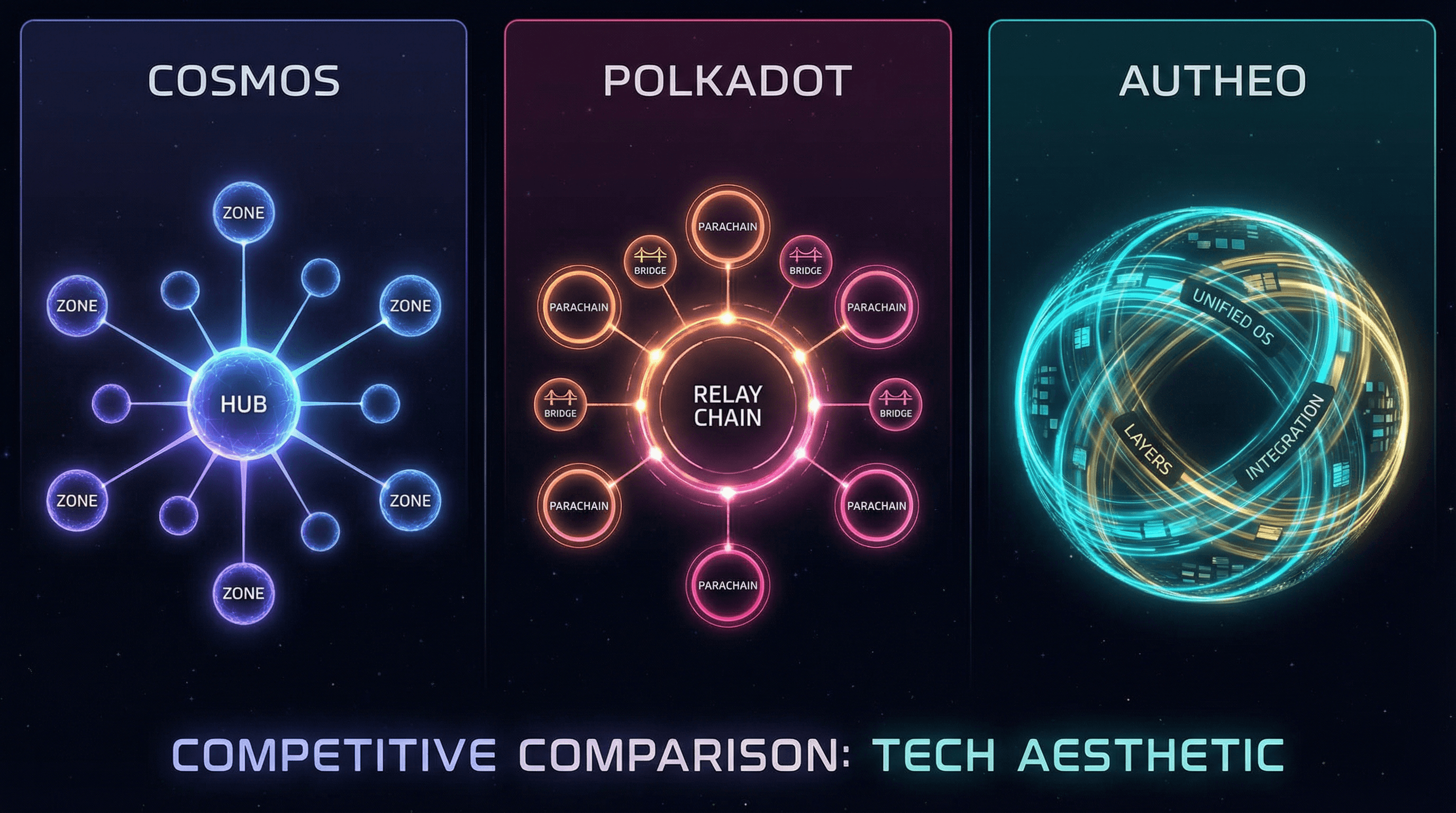
Autheo, Cosmos, and Polkadot are all Layer-0 interoperability platforms — but they take fundamentally different approaches to connectivity, security, and what it means to be infrastructure for a multi-chain world. Cosmos prioritizes chain sovereignty with production-ready IBC connecting 115+ chains. Polkadot prioritizes shared security and governance coordination for ~45 parachains. Autheo takes the most integrated approach — a full Layer-0 Operating System with native AI, compute, storage, and identity, positioning itself not as a communication protocol but as an entire unified platform.
Loading tweet...
Architecture: Three Different Philosophies
Cosmos uses a hub-and-zone model. Independent blockchains (zones) connect via the Inter-Blockchain Communication (IBC) protocol, routing messages through hubs like Cosmos Hub. Each zone maintains sovereign security — its own validator set, governance, and tokenomics. This sovereignty-first design gives developers maximum flexibility and autonomy, though it means each zone must bootstrap its own security independently.
Polkadot uses a Relay Chain and parachain model. Parachains connect to the central Relay Chain, which coordinates consensus and cross-chain messaging (XCM v3) for all connected chains. The key tradeoff: parachains inherit Polkadot's shared security without needing their own validator sets, but they operate within tighter protocol constraints and must win parachain slot auctions to join.
Autheo takes a different approach entirely. Rather than being a 'communication protocol' or a 'shared security provider', Autheo is a Layer-0 Operating System with an integrated Layer-1. It combines interoperability and execution in a single platform, adds native AI (THEO AI), decentralized compute, storage, messaging, and post-quantum identity — creating an environment where developers don't stitch together multiple services but deploy into a complete, coordinated system.
Security Models Compared
Cosmos (Sovereign Security): Each zone bootstraps its own validator set and staking economy. Full control over slashing conditions, governance, and compliance — ideal for enterprise deployments needing regional restrictions or private validators. The tradeoff: small new zones can be economically insecure until they achieve sufficient stake. Cosmos Interchain Security 2.0 allows consumer chains to optionally lease security from ATOM stakers.
Polkadot (Shared Security): All parachains inherit Relay Chain-level validation from the shared validator set. Faster time-to-market for new chains, no need to bootstrap validators — but tighter protocol constraints and governance dependence on the Relay Chain. Best for projects that want instant security and plan to focus entirely on application logic.
Autheo (Integrated Security): The QSDAG Consensus (quantum-secure DAG-based finality) and QIES Enclaves (isolated execution environments) provide security at the OS level. Post-quantum cryptography is foundational — not an upgrade path. Validators also run AI inference and compute services, creating additional economic alignment beyond pure staking.
Cross-Chain Communication
Cosmos IBC: The most production-ready cross-chain communication protocol in Web3. Over 115 chains connected, processing over $1 billion per month in IBC volume. The 2025 IBC Eureka upgrade added zero-knowledge bridging to Ethereum. Permissionless deployment means any compatible chain can connect without approval.
Polkadot XCM v3: Native cross-consensus messaging between parachains with structured message format. Strong security guarantees from shared validator set. XCMP (Cross-Chain Message Passing) is still maturing — many chains use HRMP (Horizontal Relay-routed Message Passing) as a fallback, which is heavier in cost and performance. The JAM architecture (2025) promises to reduce onboarding costs by up to 90%.
Autheo's cross-chain approach: EVM compatibility and Cosmos SDK foundation provide out-of-the-box interoperability with both Ethereum and Cosmos ecosystems. Zero-knowledge proofs power cross-chain operations without the fragmentation risks of traditional bridges. The Autheo Browser enhances application-layer interoperability beyond simple asset transfers.
Developer Experience
Cosmos SDK (Golang) is modular and widely adopted with pre-built modules for governance, staking, accounts, and IBC. Developers can spin up an appchain relatively quickly, though each zone still requires significant operational work.
Substrate (Rust) is Polkadot's development framework — extremely powerful and deeply flexible, giving developers control over runtime, consensus logic, and protocol primitives. The learning curve is steep, requiring specialized Rust expertise.
Autheo's Full-Stack SDKs provide a single framework spanning frontend, backend, smart contracts, and orchestration — reducing the expertise required to build on blockchain infrastructure. The DevHub offers native workspace for testing, deploying, and monitoring with AI-assisted orchestration. EVM compatibility means Solidity developers can deploy immediately with familiar tooling.
The Key Differentiator: OS vs Protocol
The most fundamental difference is philosophical. Cosmos and Polkadot are protocols — they provide a specific set of infrastructure primitives (interoperability, shared security) that developers integrate into their applications. Autheo is an operating system — it aims to provide the complete environment in which applications run, eliminating the need to stitch together multiple providers.
For a developer building a DeFi protocol on Cosmos, they get IBC connectivity but still need to source their own compute infrastructure, storage, AI capabilities, and identity layer. On Autheo, all of these components are integrated, coordinated, and designed to work together from day one.
Key Takeaways
- Cosmos: sovereignty-first, 115+ chains via IBC, $1B+/month volume, permissionless deployment, sovereign security per chain.
- Polkadot: shared security via Relay Chain, ~45 parachains, XCM v3 messaging, curated onboarding via parachain auctions.
- Autheo: Layer-0 OS with integrated Layer-1, AI, compute, storage, DID, and full-stack developer tooling in one unified platform.
- Cosmos wins on interoperability volume and developer velocity; Polkadot on shared security and governance coordination.
- Autheo differentiates by treating infrastructure as an OS rather than a protocol — eliminating the integration overhead of assembling a multi-provider stack.
- For projects that want to build on an integrated, AI-native, quantum-secure foundation rather than assembling components, Autheo offers a uniquely holistic environment.
Explore how Autheo compares and why builders are choosing it for their next-generation applications. Visit autheo.com or read the technical documentation at docs.autheo.com.
Get the Autheo Daily
Blockchain insights, AI trends, and Web3 infrastructure updates delivered to your inbox every morning.