



Industry Analysis
Market trends, competitor analysis, regulatory updates, and strategic insights for the Web3 ecosystem.

The Developer Is the New Attack Surface: What Fake Crypto Jobs Reveal About Trusted Infrastructure
A recent campaign that stole at least $10.7 million through fake crypto and AI job offers shows why developer security is now an infrastructure problem. Here is the practical design checklist for identity, access, and operational resilience.
Read more →
Permissioned Tokenized Stock Venues: The Infrastructure Controls 2026 Demands
The SEC's temporary path for permissioned tokenized stock venues makes one thing clear: onchain market infrastructure needs access rules, sanctions controls, issuer processes, and audit evidence designed into the product from the start.
Read more →
The Compliance Layer Is Becoming Programmable: What SEC and CFTC Relief Means for Onchain Infrastructure
New SEC and CFTC relief points toward narrower, conditional paths for onchain activity. For builders, the message is clear: compliance needs to become an observable part of infrastructure, not a promise added after launch.
Read more →
What the CLARITY Act Setback and Fed Tightening Mean for Layer 1 Infrastructure Builders
Policy uncertainty and tighter money do not pause serious blockchain infrastructure work. They raise the bar for teams building durable trust, compliance, and execution systems.
Read more →
Crypto Infrastructure Maturity in 2026: What the Clarity Act Debate and CoinEx Shutdown Reveal
The latest Clarity Act draft and CoinEx shutdown point to the same conclusion: crypto infrastructure is being judged less by promises and more by operational controls, liquidity discipline, and accountable design.
Read more →
Trust Boundaries Are the New Infrastructure: What Crypto Incidents and Payment Rails Reveal
Recent crypto security incidents and stablecoin payment launches point to the same lesson: adoption depends on explicit trust boundaries, observable operations, and settlement rails that fail safely. Here is what builders can learn and how Autheo approaches the problem.
Read more →
From Policy Promises to Production Rails: What G20 Coordination and SEC Transfer-Agent Modernization Mean for Blockchain Operators
Global policy coordination and updated transfer-agent rules are pushing blockchain infrastructure toward a more operational standard. Here is the practical checklist for operators building compliant, reliable digital-asset rails.
Read more →
Australia's Crypto Licensing Deadline: The Production Controls Web3 Operators Need Before October
ASIC's September 30, 2026 deadline turns licensing relief into an operational test. Here is the production-control checklist digital-asset operators need for market access, custody, settlement, and evidence.
Read more →
Tokenized Equities After Hours: The Infrastructure Checklist for Regulated Rails in 2026
Tokenized equities are moving beyond pilot programs into broader distribution and longer trading windows. Here is the infrastructure checklist for backing, settlement, collateral, identity, and resilient execution.
Read more →
When One Chain's Growth Becomes Another Protocol's Revenue: Robinhood Chain, Uniswap, and Infrastructure Value Capture
Robinhood Chain just hit $3 billion in daily DEX volume, and Uniswap captured 98% of it and 66% of its own global revenue from that one chain. Here is what that value-capture gap reveals about modular blockchain economics.
Read more →
Robinhood Chain Explained: The Architecture Behind a Brokerage's Own Layer 2
What Robinhood Chain actually is: an Arbitrum Orbit layer 2 with chain ID 4663, ERC-20 stock tokens, and no native coin, and why a mainstream brokerage building its own chain signals a bigger shift in Web3 infrastructure.
Read more →
Institutional Blockchain Rails in 2026: Tokenized Funds, Custody Compliance, and Operational Resilience
Institutional blockchain adoption is moving from experiments toward production rails. This guide explains what tokenized funds, regulated custody, and recent network outages teach builders about designing compliant, resilient infrastructure.
Read more →
Bitcoin's 22% Rally: What's Actually Driving It, and What It Doesn't Prove Yet
Bitcoin jumped from about $62,800 to above $80,000 in a week. Here is the data behind the four catalysts, and why the move alone does not yet confirm a new bull market.
Read more →
Autheo vs Near Protocol for Decentralized AI Integration
NEAR has built the strongest AI-adjacent product suite among general-purpose L1s, with a live confidential GPU marketplace and agent runtime. Autheo bets on a Layer-0 OS with AI natively woven in. Here's an honest look at both, including what's live today versus still rolling out.
Read more →
RWA Tokenization Beyond Stocks: What's Actually Working in Bonds, Real Estate, and Commodities
Beyond stocks, tokenized Treasuries and gold show real traction, while real estate exposes the legal and operational limits of RWA hype.
Read more →
Why Tokenized Stock Prices and Liquidity Look Different From the Real Thing
Why tokenized stock prices and liquidity can diverge from listed shares, from NAV gaps and gating to 24/7 trading and fragmented markets.
Read more →
Autheo vs Avalanche for Scalable Blockchain Apps
Avalanche's customizable L1 model gives teams fast finality and full chain control, but each L1 is its own operational and security surface. Autheo's single validator network gives full-stack access without spinning up a new chain. A dedicated, sourced head-to-head for 2026.
Read more →
Build for Policy Uncertainty: A Tokenized Asset Architecture That Survives 2026
The latest CLARITY Act text may change before it becomes law. Here is a practical architecture for tokenized assets and stablecoin programs that can adapt without forcing a rewrite of custody, compliance, settlement, or developer tooling.
Read more →
Autheo vs Chainlink for Oracle and Interoperability
Chainlink secures more than $27 trillion in value as the industry-standard oracle network. Autheo is a Layer-0 OS, not an oracle replacement. Here's an honest comparison of what each actually does, and where they overlap and don't.
Read more →
How Autheo Compares to Sui for Enterprise Blockchain Deployments
Sui delivers high-throughput parallel execution for enterprises building fast, single-purpose chains. Autheo takes a different bet: a Layer-0 OS with native post-quantum security and AI orchestration. Here's an honest comparison of both, including what's live today versus still rolling out.
Read more →
How GSI Partnerships Are Shaping Blockchain Infrastructure Providers
Global Systems Integrators like Accenture, Deloitte, TCS, Infosys, and Wipro are becoming a primary channel for enterprise blockchain adoption. Here's how the GSI partnership model works, and how Autheo's own approach fits into it.
Read more →
Autheo vs AWS for Decentralized Cloud Computing and Storage
AWS runs 31% of the world's cloud market but carries US CLOUD Act exposure, vendor lock-in, and regional single points of failure. Autheo is building a decentralized validator network with a Decentralized Cloud Computing layer and ABW34 storage, not yet live, rolling out over the coming months. Here is an honest comparison of both.
Read more →
Choosing Between Autheo and Polygon for Enterprise Web3
Polygon scales Ethereum with a PoS sidechain, zkEVM, and AggLayer, winning enterprise pilots from Starbucks to Stripe. Autheo is a sovereign Layer-0 OS with native AI tooling, post-quantum security, and no Ethereum settlement dependency. Here is how the two actually compare for enterprise Web3 in 2026.
Read more →
When Wall Street Backs Crypto Rules: A Builder's Guide to Tokenized Assets
BlackRock, Fidelity, Franklin Templeton, Goldman Sachs, and SoFi have backed the CLARITY Act. Here is how developers should read that signal, design for uncertainty, and build tokenized asset and stablecoin products that can adapt.
Read more →
Autheo vs Hyperledger Indy vs Sovrin vs uPort: Best Blockchain Platform for Sovereign Identity Management (2026)
Autheo, Hyperledger Indy, Sovrin, and uPort take four different approaches to sovereign identity. Here's an honest look at what's actually live in 2026, including why Autheo's TheoID isn't one of them yet.
Read more →
CLARITY Act in 2026: The Enterprise Checklist for Tokenized Products (Custody, Disclosures, Insolvency, and DeFi Edges)
A practical enterprise checklist for tokenized products under U.S. market-structure proposals like the CLARITY Act: custody, disclosures, insolvency treatment, and safer DeFi edges you can design for now.
Read more →
CLARITY Act Meets DeFi in 2026: How Vaults and Onchain Lending Can Stay Compliant Without Killing UX
If your DeFi vault or onchain lending product involves discretion over allocations, rates, or risk parameters, treat compliance like a product spec. Here is a builder playbook for designing auditable rules, user disclosures, and operational controls in a CLARITY Act era.
Read more →
How U.S. crypto market-structure bills (like the Clarity Act) can move risk appetite: a practical checklist for builders and investors
How U.S. crypto market-structure bills (like the Clarity Act) can move risk appetite: a practical checklist for builders and investors U.S. crypto market-structure bills can change risk appetite long before a vote happen
Read more →
Freeze-Resistant Stablecoins in 2026: A Compliance-First DeFi Design Guide
Freeze-resistant stablecoins remove issuer-level freezes. This guide explains what that changes for DeFi and payments teams, and how to design monitoring, allow/deny lists, and fallback controls without killing composability.
Read more →
FATF's 7th Update and the Rise of Freeze-Resistant Stablecoins: A Builder's Compliance Playbook for 2026
FATF's latest update shows compliance is spreading fast, but enforcement is uneven. That combination is fueling new stablecoin designs marketed as "freeze-resistant." Here's what that means for builders, exchanges, and infrastructure teams, plus the controls you should implement now.
Read more →
When Rules Slip: Designing Stablecoin and Token Systems That Stay Compliant
A field-tested architecture playbook for stablecoin issuers and onchain payment teams when compliance deadlines stay fixed but implementing rules arrive late.
Read more →
Cross-Border Stablecoins + Sanctions in 2026: A Compliance Playbook for Exchanges and Payment Integrators
Cross-border stablecoins are getting more official, and sanctions compliance is getting more address-specific. The practical takeaway for exchanges and payment integrators is simple: treat stableco...
Read more →
How Autheo Compares to Solana for Scalable Blockchain Apps
Solana wins on raw throughput and ecosystem size, processing thousands of real-world transactions per second with fees near a fraction of a cent. Autheo wins on finality...
Read more →
Crypto in 2026: What Actually Changed and What's Still Broken
A state-of-the-industry assessment for people who've heard a lot about crypto but aren't sure what to believe. What worked, what didn't, and what the next wave actually looks like.
Read more →
Choosing Between Autheo and Algorand for Enterprise Deployments
For most enterprise use cases, Autheo is the better fit because its hybrid Proof of Autheo consensus pairs licensed validator accountability with post-quantum security and a...
Read more →
What the SEC’s 2026 Regulatory Agenda Means for Tokenized Securities Custody, Trading, and Builders
If you build tokenized securities or infrastructure around them, the SEC’s 2026 regulatory agenda is a signal that the rules are going to get clearer, not looser. The direction...
Read more →
Robinhood Chain and Tokenized Equities in 2026: What It Means for Onchain Brokerage Infrastructure
Robinhood Chain is a signal that tokenized equities are moving from pilots into a real onchain brokerage stack. Here is what permissionless L2 infrastructure changes, what it cannot change, and the five-layer blueprint builders can use to ship compliant markets.
Read more →
CLARITY Act Timing + ETF Flows: A Practical Liquidity Playbook for L1 Teams in 2026
Galaxy now puts the CLARITY Act’s 2026 odds at 50-50 due to Senate floor-time constraints, while ETF flow regimes keep flipping risk appetite on and off. Here is a practical liquidity playbook for L1 teams.
Read more →
The Problem with Every Blockchain You've Heard Of
Ethereum, Solana, Polkadot, Cosmos, Avalanche. Each one solved a real problem. Each one created new ones. Here's an honest tour of what each got right, what each got wrong, and what comes next.
Read more →
The Internet You Were Promised vs. The Internet You Got
The early internet promised open, decentralized access for everyone. What arrived was five companies controlling the cloud, the social graph, the ad stack, the app stores, and the payment rails. Here's what happened, and what's actually being done about it.
Read more →
SEC and CFTC Derivatives Definitions Review (2026): What the New Request for Comment Means for Crypto Perps, Swaps, and Builders
The SEC and CFTC just opened a 60-day request-for-comment to revisit the definitions of swap, security-based swap, and mixed swap. Here’s what that could change for crypto-linked derivatives, perpetuals, and the compliance architecture builders need in 2026.
Read more →
Sanctions-First Compliance in 2026: A Practical Stack for Crypto Builders (Before You Ship)
A practical, event-driven blueprint for sanctions-first compliance: what to screen, when to screen it, and how to log decisions without wrecking UX.
Read more →
A Japanese Pension Fund Just Bought Crypto for the Same Reason It Buys Gold
Japan's National Business Enterprise Pension Fund, covering roughly 1,200 SMEs and 20,000 workers, announced on June 21, 2026 that it will allocate 1% of assets to a passive multi-crypto fund. The fund's framing: currency hedge, not speculation. When institutions enter at this scale, they are implicitly betting on the infrastructure layer being sound. Here is what institutional-grade blockchain infrastructure actually requires.
Read more →
Ethereum Is Down 60% Against Bitcoin in 2026. The Infrastructure Lesson Nobody Is Drawing.
The ETH/BTC ratio dropped roughly 60% in the first half of 2026. Most coverage treats this as a price story. It is also an infrastructure story: developers now have more Layer-1 and Layer-2 options than ever, and they are sorting chains by fee predictability, halt history, language support, and composability. This post draws the architectural lesson that the price charts are pointing at.
Read more →
AI Agents Are Getting Official Digital Identities: What Estonia's Move Means for Web3 Builders
On June 17, 2026, Estonia's Prime Minister approved a proposal to give AI agents their own official digital identity codes, distinct from their human owners. It is the first government to do this. Here is what the decision means for Web3 builders working on agent infrastructure, decentralized identity, and the emerging AI-native economy.
Read more →
Autheo vs. Polkadot, Cosmos, and Avalanche: Why the Layer-0 OS Model Wins in 2026
Polkadot runs parachain slot auctions worth 30 to 50 million DOT per slot. Cosmos adds IBC relayer complexity to every cross-chain app. Avalanche splits execution across three separate chains. Autheo operates at a different layer entirely: a Layer-0 OS that integrates compute, storage, identity, and post-quantum security as native protocol primitives, giving builders and token holders six distinct THEO demand vectors where competitors offer one or two.
Read more →
CFTC’s Perpetual-Futures Relief (26-19) and Stablecoin Reserve Rules: What They Signal for Onchain Derivatives and Payment Rails in 2026
If you build anything that looks like onchain derivatives or stablecoin settlement, 2026 is shaping up to be less about vibes and more about rule-shaped product decisions. Two signals matter a lot ...
Read more →
Tokenized Securities Pilots in 2026: What DTC-Style Settlement Tests Mean for Onchain Builders
Tokenized securities pilots are testing onchain settlement within existing market rules. Here is how builders should design for compliance, identity, reconciliation, and scale.
Read more →
The AudiA6 Takedown in 2026: A Practical KYT and AML Playbook for Exchanges and Web3 Builders
What the AudiA6 takedown implies for AML ops in 2026: KYT alert design, mule-network detection, freeze/hold UX, incident documentation, and developer supply chain security.
Read more →
What Happened to Sovrin Network? SSI's Next Chapter
Sovrin Foundation dissolved May 21, 2025. Here's why it collapsed, and why the self-sovereign identity market it pioneered is still projected to hit $44.98B by 2032.
Read more →
Ethereum vs. a Layer-0 OS: The Fragmentation Tax Web3 Developers Are Paying
50+ Ethereum L2s. Multiple deployment targets. Bridges between them. Ethereum's own blog called L2 fragmentation its highest-leverage problem. Here's what the fragmentation tax actually costs.
Read more →
Sanctions Compliance For Crypto In 2026: How To Build A Program That Survives Ofac Designations And Secondary-Risk Pressure
A practical, engineering-first sanctions compliance blueprint for crypto teams navigating OFAC designations, vendor pressure, and secondary-risk dynamics in 2026.
Read more →
Sui's 2026 Mainnet Halts: What Broke & Reliability Fixes
Sui's May 2026 mainnet halts exposed real gaps in upgrade and fee-logic reliability. Root-cause breakdown plus a validator reliability checklist for any L1.
Read more →
Code Is Speech, But Shipping DeFi Is Still Risky: Practical Compliance Guardrails for Non-Custodial Teams
A practical guide to non-custodial DeFi compliance guardrails: how to design keys, upgrades, UI safety rails, and documentation so you reduce risk without becoming an intermediary.
Read more →
Tokenized Equities in 2026: Why Most Markets Are Still Compliance-Gated (and What Builders Should Do)
Tokenized equities are real, but most onchain share markets in 2026 are still compliance-gated: allowlists, transfer restrictions, and controlled onboarding so issuers and transfer agents can meet recordkeeping, AML, and sanctions obligations. Here's the builder playbook for designing tokenized equity infrastructure that can ship now and open up safely over time.
Read more →
The SEC’s Draft Strategic Plan (2026) and What It Signals for Crypto Market Structure
The SEC’s draft strategic plan is not a rule, but it previews the agency’s direction on digital assets. Here’s how builders can turn that signal into a concrete 2026 watchlist and compliance-ready roadmap.
Read more →
Tokenized Public Equities in 2026: How Transfer Agents, Allowlists, and Settlement Actually Work
Tokenized public equities are closer to production, but transfer-agent records, allowlists, and settlement rules still decide what can trade and who can hold it. Here's the workflow teams actually need in 2026.
Read more →
Sanctions Screening for Crypto in 2026: A Practical Compliance Playbook for Exchanges, Wallets, and Builders
A practical, implementation-oriented guide to sanctions screening in crypto: what to screen, how to match without drowning in false positives, and how to run a defensible case workflow in 2026.
Read more →
Tokenized Treasurys and RWA Rails in 2026: What Scaled, What’s Still Missing, and the Builder Playbook
Tokenized Treasurys pushed real-world asset (RWA) tokenization past the $30B mark. But most onchain assets still behave like digitized receipts, not composable building blocks. Here’s what the data says, what’s missing, and how to design RWA rails that actually interoperate.
Read more →
The CLARITY Act Draft in 2026: A Builder and Validator Playbook for Compliance, Ops, and Tooling
A practical, engineering-first translation of the CLARITY Act draft into a compliance, tooling, and validator-ops checklist you can start this quarter.
Read more →
The SEC-NFA MOU in 2026: What Coordination Means for Crypto Compliance, DeFi Builders, and Market Structure
SEC and NFA coordination is not a new rule, but it can speed up how exam and enforcement priorities move across markets. Here is what builders should change now, what to ignore, and…
Read more →
The Clarity Act Stablecoin Compromise Just Rewrote Product Design for Issuers, Exchanges, and DeFi
Senate negotiators just banned interest-bearing stablecoins while carving out activity-anchored rewards, and Polymarket's Clarity Act odds jumped from 46% to 64% overnight. Here is the 90-day product redesign issuers, exchanges, and DeFi teams need to ship before markup.
Read more →
Agentic Payments Need Crypto Rails. Here Is What That Actually Means for L1 Infrastructure.
PayPal and Google just told Consensus Miami that AI agents will run on crypto rails. Google's Agentic Payments Protocol has 120+ partners. Here is the four-property bar L1 infrastructure has to clear, and what protocol leads should commit to in the next 90 days.
Read more →
AI-Native Banking and Stablecoin Settlement: What the OCC's Conditional Approval Signals for Builders in 2026
The OCC's conditional approval for an AI-native, stablecoin-first clearing bank is a signal: stablecoins are moving from a crypto product to a supervised settlement rail. Here's what that means for L1 builders, payment app developers, and compliance teams in 2026.
Read more →
Stablecoins as the Default Settlement Layer in 2026: What Builders and Compliance Teams Must Get Right
Stablecoins are quickly becoming the default settlement layer for apps and institutions. This guide breaks down the compliance questions, risk controls, and design patterns builders should implement in 2026.
Read more →
The SEC/CFTC 2026 Token Taxonomy: A Developer's Guide to Staking, Airdrops, and Classification
The SEC and CFTC's joint interpretation rewrote how US securities law applies to crypto. Here is what the new five-category taxonomy means for developers building tokens, running staking programs, and shipping airdrops in 2026.
Read more →
Agentic Payments in 2026: Why AI Agents Need Crypto Rails (and What L1 Infrastructure Must Provide)
AI agents can browse, negotiate, and execute, but they still hit a wall at checkout. This guide explains why stablecoins are becoming the default payment rail for agents, how standards like AP2 structure intent and accountability, and what L1 infrastructure must deliver to make machine-to-machine commerce safe.
Read more →
Stablecoin Yield Bans in 2026: Compliance-Safe Reward Design Patterns That Still Work
Stablecoin rules are drawing a hard line between passive, deposit-like interest and rewards earned through real activity. Here are compliance-safe patterns teams can use in 2026, plus how to implement them with onchain proofs and infrastructure.
Read more →
DePIN in 2026: The KPI Playbook for Token Incentives That Actually Map to Infrastructure
DePIN is maturing from a narrative into an operator discipline. This KPI playbook shows founders how to tie token incentives to verifiable usage, track real revenue, and avoid vanity metrics across compute, storage, and connectivity networks.
Read more →
Multi-Chain Stablecoin Settlement Rails: What Visa and Banks Are Building, and What L1s Must Get Right
Payment networks are turning stablecoins into real settlement infrastructure across multiple chains. Here is what that shift means for L1 and L2 design: finality, auditability, identity, and post-quantum readiness.
Read more →
Beyond Code Audits: Managing Non-Financial Risk Across Your Blockchain Stack
Smart contract audits catch bugs, but they don't catch node outages, sequencer failures, bridge exploits, or quantum threats. Here's how to build a risk framework that covers your entire blockchain stack.
Read more →
Real-World Asset Tokenization Hit $30 Billion. Here Is What Is Actually Working (and What Is Not)
Real-world asset tokenization hit $29.9 billion in April 2026, more than tripling from $8.8 billion a year earlier. But most of that growth is concentrated in treasuries and money market funds, while illiquid assets like real estate remain stubbornly hard to tokenize at scale.
Read more →
Why Enterprises Are Building Their Own Blockchains: The Rise of App-Specific Chains for Payments
Enterprises are no longer asking whether blockchain fits their payment operations. They're asking which chain architecture fits their use case. App-specific chains are becoming the answer, and the shift has real momentum behind it.
Read more →
Why Creators Are Betting on Web3: Ownership, Revenue, and the End of Platform Dependency
The creator economy is on its way to $500 billion by 2027, but most creators still don't own their audiences, their content, or their income. Web3 is changing that, here's how.
Read more →
You Can Now Own a Piece of Almost Anything: The Real-World Asset Revolution
Tokenized real-world assets grew from nearly nothing to over $24 billion by early 2026, and BlackRock, JPMorgan, and Fidelity are leading the charge. Here's what it means for everyday investors.
Read more →
Tokenization Policy in 2026: Why Neutral Infrastructure Rails Are the Battleground
"As regulators in the U.S., EU, and Asia race to define tokenization policy in 2026, the real battleground is not which assets get tokenized, it is which infrastructure rails will carry them. Neutral, decentralized platforms like Autheo are positioned to become the default settlement layer for the tokenized economy."
Read more →
The $500B Opportunity: Where Web3 Infrastructure Is Heading
The Web3 infrastructure market is one of the fastest-growing segments in technology today, currently valued at roughly $10–14 billion and projected to expand to $194 billion by 2036, with some analyst estimates placing the total addressable market well above $500 billion when DePIN, AI-integrated b
Read more →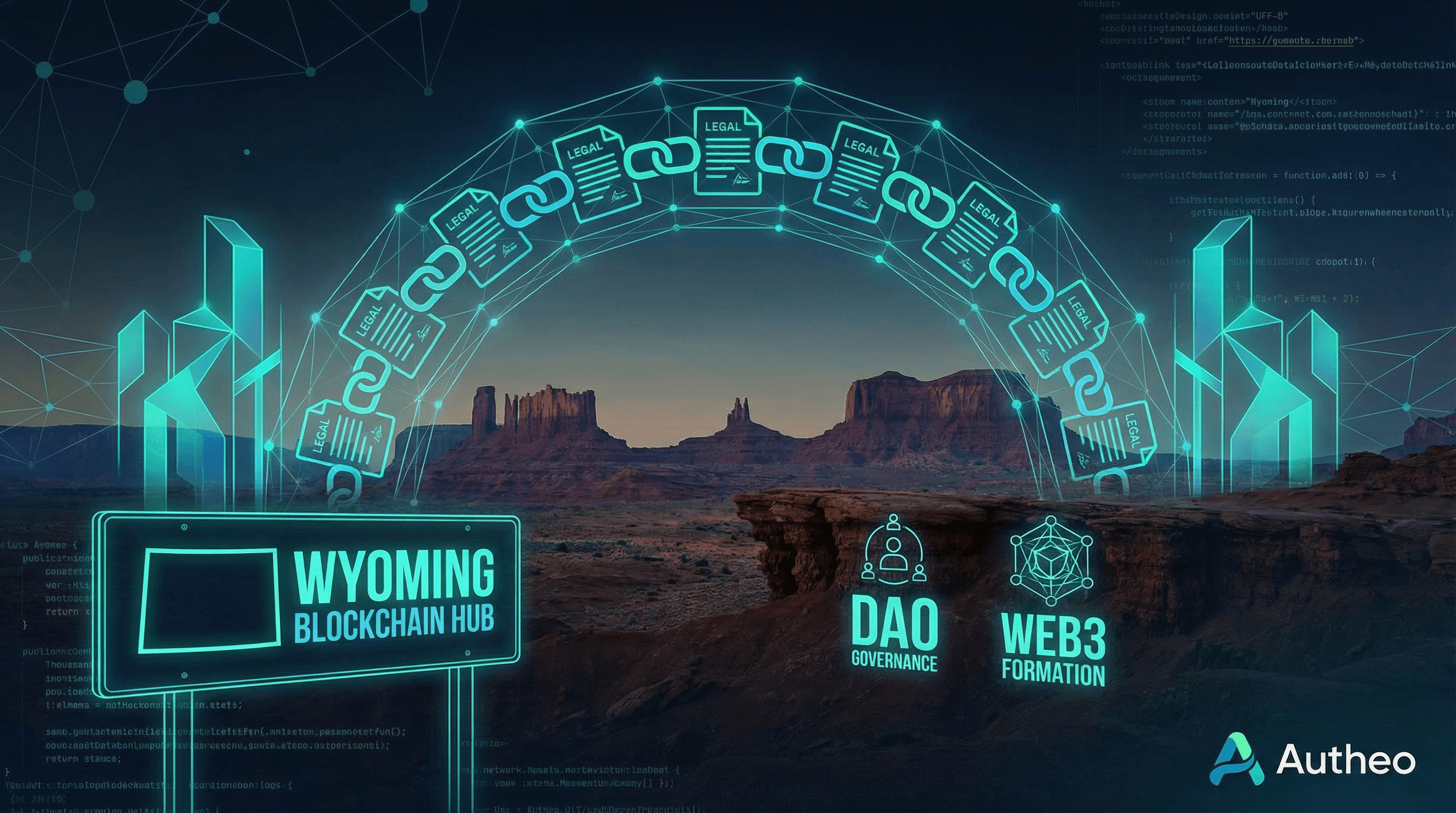
Why Wyoming Is Becoming the Delaware of Web3
Wyoming has passed 30+ blockchain laws since 2018, including the first DAO LLC legislation, DUNA Act (2024), and SPDI banking charter for digital asset custody, creating the most comprehensive Web3 legal framework in the US, with no state income tax on crypto income and unmatched regulatory clarity for blockchain infrastructure companies.
Read more →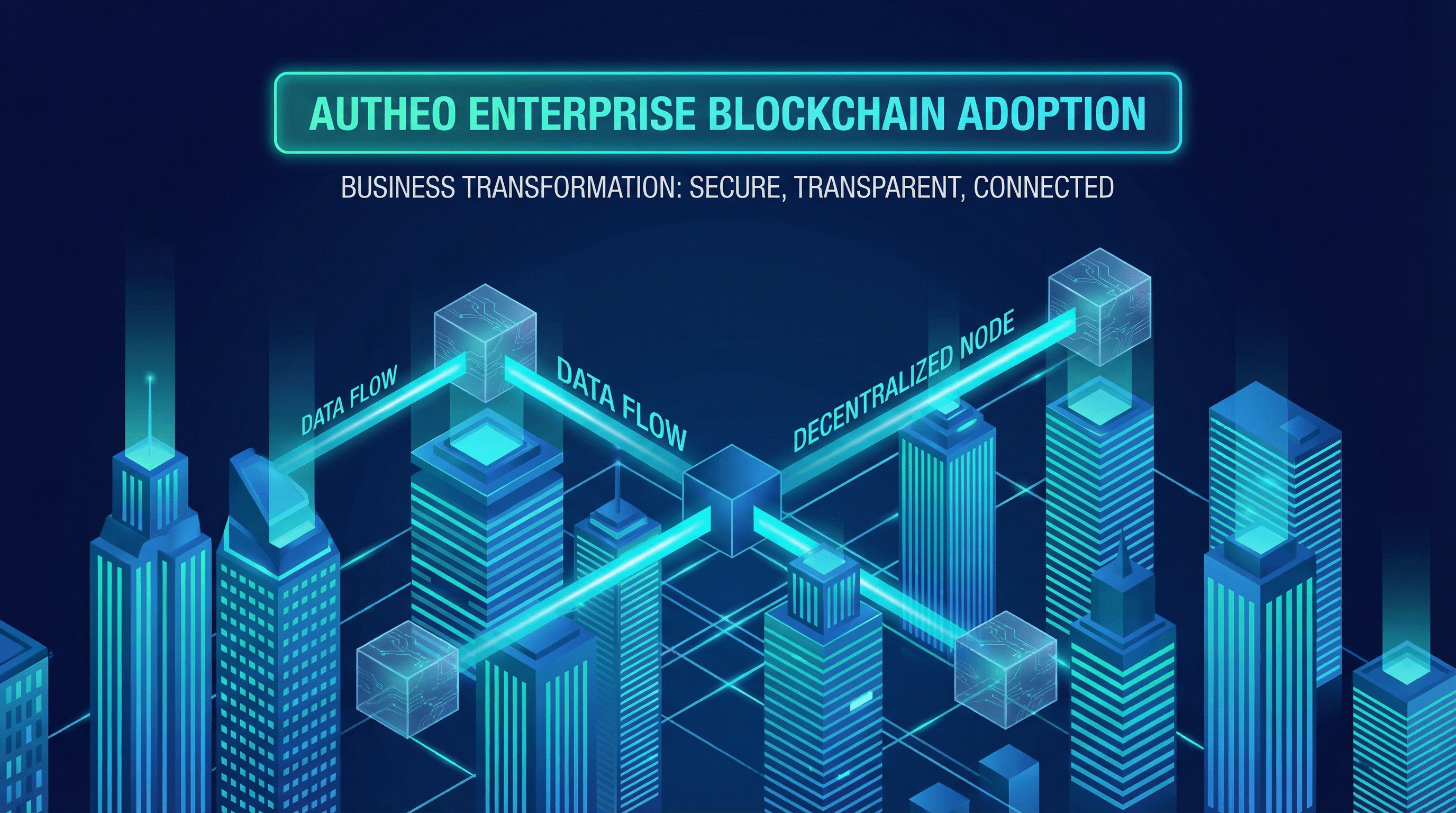
Why Enterprise Blockchain Adoption Is Accelerating in 2026
Enterprise blockchain adoption is accelerating in 2026 driven by regulatory clarity (MiCA, U.S. digital asset guidance), demonstrated ROI (DeFi processed $2T+ in 2025; supply chain reduces counterfeiting by 30%), and technology maturity, with the market projected to grow from $12.77B to $29.29B by 2033.
Read more →
The State of Web3 Infrastructure in 2026
Web3 infrastructure in 2026 has entered a definitive maturity phase, generating multi-billion revenues, supporting enterprise production deployments, and converging with AI, marked by modular architecture, cross-chain interoperability, and institutional adoption at unprecedented scale.
Read more →