



The Open Foundation: Why the Next Internet Won't Run on Someone Else's Cloud
The Open Foundation: Why the Next Internet Won't Run on Someone Else's Cloud
The next internet will run on infrastructure no single company owns. As AI agents begin to outnumber human builders by orders of magnitude, the foundation they run on can't be priced, policed, and switched off by three providers. A distributed cloud platform, where independently owned hardware behaves like one logical cloud and a neutral blockchain handles trust, is the better foundation for what comes next.
This post opens The Open Foundation, a new Autheo series on risk, resilience, sovereignty, and the agent economy. Over the next 90 days we'll test one idea from every angle: the internet's next layer should be open by design.
Three Companies Hold the Keys to the Modern Internet
Today's internet sits on a remarkably small number of landlords. In the second quarter of 2026, worldwide spending on cloud infrastructure services hit $143.4 billion, and AWS, Microsoft, and Google together captured 67% of it, according to Synergy Research Group data reported by CRN. AWS alone held 28%, Azure 20%, and Google Cloud a record 15%.
That concentration is accelerating, not easing. The four largest U.S. cloud and platform companies have committed up to roughly $725 billion in capital spending for 2026, most of it for AI data centers and accelerators, as NextMSC reported. When that much physical infrastructure sits with a handful of firms, the rest of the economy becomes a tenant.
Being a tenant was a reasonable trade for the first cloud era. You gave up control and got elasticity, speed, and someone else's operations team. The question this series asks is whether that trade still makes sense when the main users of compute are no longer people.
The Agent Era Changes the Math
SoftBank's Masayoshi Son has described a future of roughly 1,000 AI agents for every human developer, backed by plans to deploy a billion agents, according to a summary of his remarks. Whether the final ratio is 100:1 or 1,000:1, the direction is clear: software is starting to build, run, and pay for software.
The demand curve already shows it. Milk Road AI, citing an Evercore ISI chart, noted that annual token usage is projected to climb to roughly 4,000 quadrillion tokens per year by 2030, and that "agents call models repeatedly, check their own work, and use other tools without waiting for a human at each step," as Milk Road AI wrote on X. The same post made the physical point plainly: "Every token requires chips, memory, networking, electricity, and cooling."
Raoul Pal, co-founder of Real Vision, frames the shift as an economy, not a feature. "An agentic economy is coming... billions of AI agents doing real economic work, transacting with each other constantly, at machine speed," he wrote in DeFi Wasn't Meant For You. Infrastructure designed around human accounts, credit cards, and support tickets wasn't built for that tempo.
If you want the background on how agents and chains fit together, our explainer on AI agent identity and trust infrastructure covers the basics.
Risk: Concentration Is a Single Point of Failure
On October 20, 2025, a fault in AWS's US-EAST-1 region cascaded into failures across consumer apps, banks, government portals, and parts of Amazon itself. Downdetector logged more than 17 million user reports and disruptions at over 3,500 companies, according to Ookla. A postmortem by ilert traced it to a faulty load balancer health monitor that degraded thousands of apps for roughly 15 hours.
None of those companies did anything wrong on their own systems. They simply shared a failure domain with everyone else in the same region. That's the hidden cost of concentration: your uptime is only as good as a provider decision you can't see.
Now multiply that by agents. A human can wait out an outage. A fleet of agents running payments, logistics, or customer operations will stall, retry, and pile up in ways that amplify the damage. The more autonomous the economy becomes, the more expensive a single point of failure gets.
Resilience: Independently Owned Infrastructure Fails Better
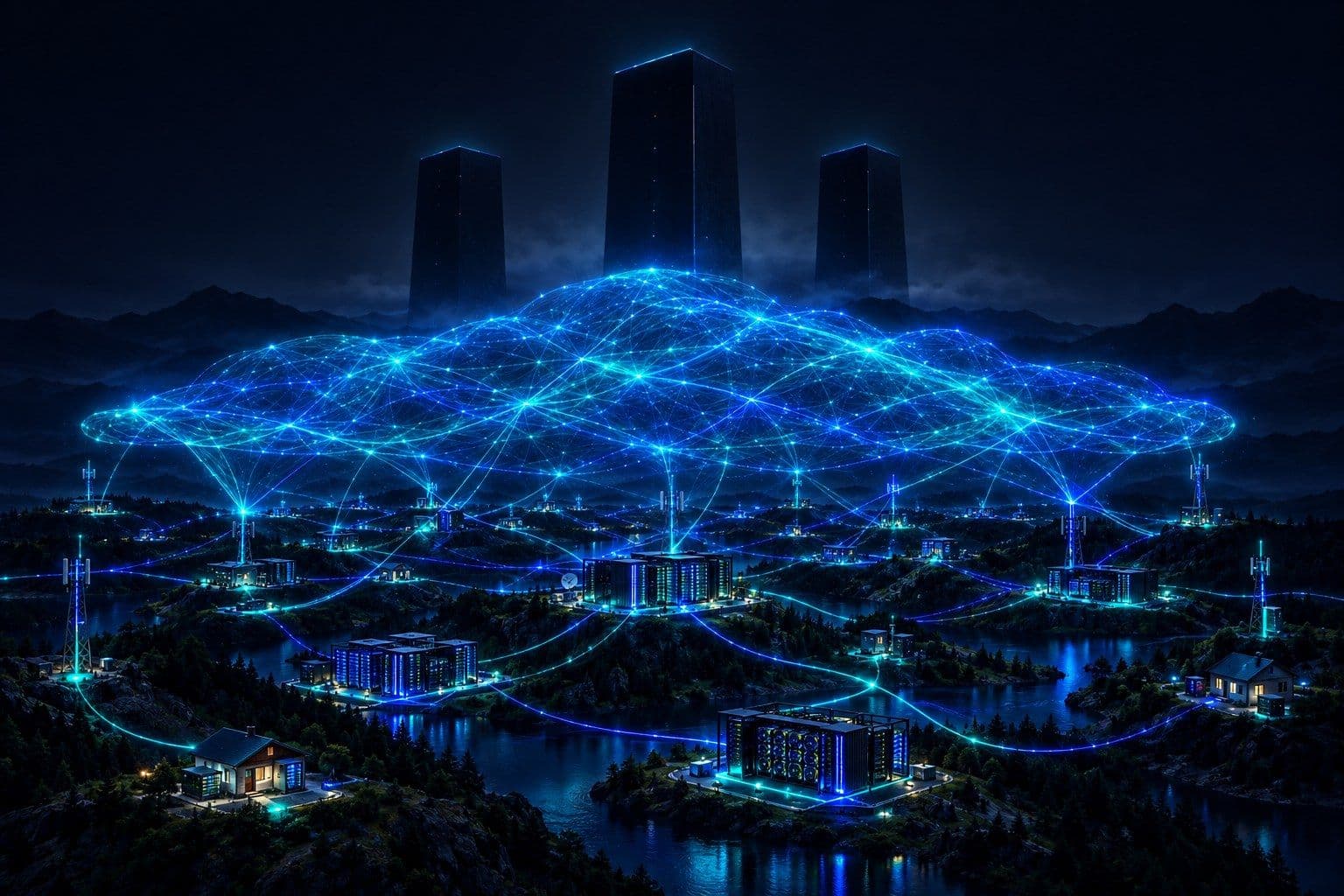
The simplest way to understand Autheo is that we are building a distributed cloud platform, not just a blockchain. The goal is to make independently owned resources behave like one logical cloud: enterprise datacenters, GPU clusters, university clusters, edge sites, factory systems, and even home labs. The platform is designed to coordinate resources rather than needing to own all of them.
That design changes how failure works. When capacity comes from many owners in many places, an outage at one site is a routing problem, not a headline. The Mesh Network is designed to handle peer discovery and routing across those independent operators, and the Edge Fabric is designed to deliver services close to users. Our guide to decentralized cloud computing walks through the model in plain terms.
One clarification matters here. The blockchain is not executing those workloads.
Execution is designed to happen in the compute, edge, and mesh layers as they roll out. The blockchain's job is trust, identity, ownership, settlement, and coordination. On-chain trust, off-chain execution.
Sovereignty: Who Decides What You Can Access?
Peter Diamandis put the core question bluntly on his Moonshots podcast: "Who decides what level of intelligence you and your company are allowed to access?" as recapped in his Metatrends summary. On the same episode, Dave Blundin asked, "At the end of the day, who owns AI? Is it the government or is it the corporations?"
Governments and regulated industries are answering with their budgets. Gartner forecasts that worldwide sovereign cloud infrastructure spending will reach $80 billion in 2026, up 35.6% from 2025, as CIO Dive reported. In Europe, the EU Data Act will remove cloud switching charges, including data egress fees, from January 12, 2027, according to the European Commission.
Regulation can lower the cost of leaving a provider. It can't change who owns the trust layer underneath. On Autheo, that layer is a Layer 1 secured by validators rather than a single operator, so no one company can unilaterally rewrite who holds what, who paid whom, or who is allowed to participate. For a side-by-side view, see how Autheo compares with AWS for cloud computing and storage.
Where Will the Network Effects Live?
Andrew Chen, author of The Cold Start Problem, recently argued that agents don't automatically have network effects, because "your agent can talk to my agent, just as Gmail can send email to Outlook." The real fight, he wrote, is over identity, reputation, relationships, and context. "The much more consequential question is: Where will the network effects live?" he asked in Will agents have network effects?
His warning is the same one we have about hyperscalers. If a few platforms capture identity and reputation and keep them proprietary, "switching agents starts to mean leaving your network behind." The alternative he describes is closer to the open web: "Identity could become an open protocol. Reputation could live in marketplaces."
That is the case for a neutral trust layer, one no single platform controls.
Autheo runs on Proof of Autheo, a hybrid consensus model combining licensed validator eligibility with stake-weighted block production. To participate as a validator, operators must hold an Autheo NFT License and meet the required staking or bonding threshold. Once both requirements are met, the active validator set operates using a standard Proof-of-Stake model, where validators earn rewards and produce blocks in proportion to their stake. The underlying framework is built on Cosmos SDK and Tendermint core BFT, providing Byzantine fault-tolerant finality and proven production-grade security.
You can learn more about Proof of Autheo on our technology pages.
Why Crypto Rails, and Why Now
Not everyone is convinced agents need a blockchain. On Moonshots' Davos 2026 episode, Alex Wissner-Gross asked why an agent can't "just make an API call and open a bank account," while Salim Ismail countered that "crypto has survived long enough to become infrastructure," according to an episode summary. We'll take the skeptic's side seriously in a later post.
The short answer is that agents need three things banks and cloud accounts weren't built to give them: verifiable identity, programmable permissions, and settlement at machine speed. As Raoul Pal put it, "Onchain rails are the only thing built for that tempo," in a post on X. Our deep dive on why agentic payments need crypto rails covers the mechanics.
Here's where Autheo stands today, stated plainly. Mainnet went live on May 14, 2026, and staking and transaction fees are live now. Decentralized compute and storage through the Autheo Marketplace, AI inference, and the TheoID identity layer are rolling out over the coming months. THEO, Autheo's native coin, is designed to connect the trust layer to the infrastructure economy as those layers come online.
What This Series Will Cover
Over the next 13 weeks, The Open Foundation will take this thesis into specific markets and test it against the news. We'll look at concentration risk and egress economics, then at why social networks and games are moving toward open infrastructure, including why community-run Minecraft servers are a natural fit for a mesh. We'll close with edge intelligence, robotics, and what it takes for machines to trust each other.
Every week we'll also publish a short post on one workload that open infrastructure is designed to serve better than a hyperscaler, from data residency to university clusters to home labs. If you're new to the architecture, start with our complete guide to Autheo and our explainer on the benefits of a Layer-0 operating system.
Raoul Pal offered a line that sums up the opportunity for builders and infrastructure owners alike: "You don't have to work at machine speed. You just have to own what the machines run on."
Key Takeaways
AWS, Microsoft, and Google captured 67% of $143.4 billion in Q2 2026 cloud infrastructure spending, concentrating risk for everyone who builds on them.
The October 2025 US-EAST-1 outage disrupted more than 3,500 companies, showing how shared failure domains spread damage.
Agent workloads are multiplying compute demand, and agents need identity, permissions, and machine-speed settlement that legacy accounts don't provide.
Autheo is a distributed cloud platform: a blockchain for trust and settlement, and independently owned infrastructure for execution.
Staking and transaction fees are live on Autheo mainnet today; compute, storage, AI inference, and TheoID are rolling out over the coming months.
The key question for the agent era, in Andrew Chen's words, is where the network effects will live. We think the answer should be open rails.
Ready to build on an open foundation? Explore the platform at autheo.com and follow The Open Foundation series as it unfolds.
Gear Up with Autheo
Rep the network. Official merch from the Autheo Store.


Theo Nova
The editorial voice of Autheo
Research-driven coverage of Layer-0 infrastructure, decentralized AI, and the integration era of Web3.
About this author →Get the Autheo Daily
Blockchain insights, AI trends, and Web3 infrastructure updates delivered to your inbox every morning.