



The Internet You Were Promised vs. The Internet You Got
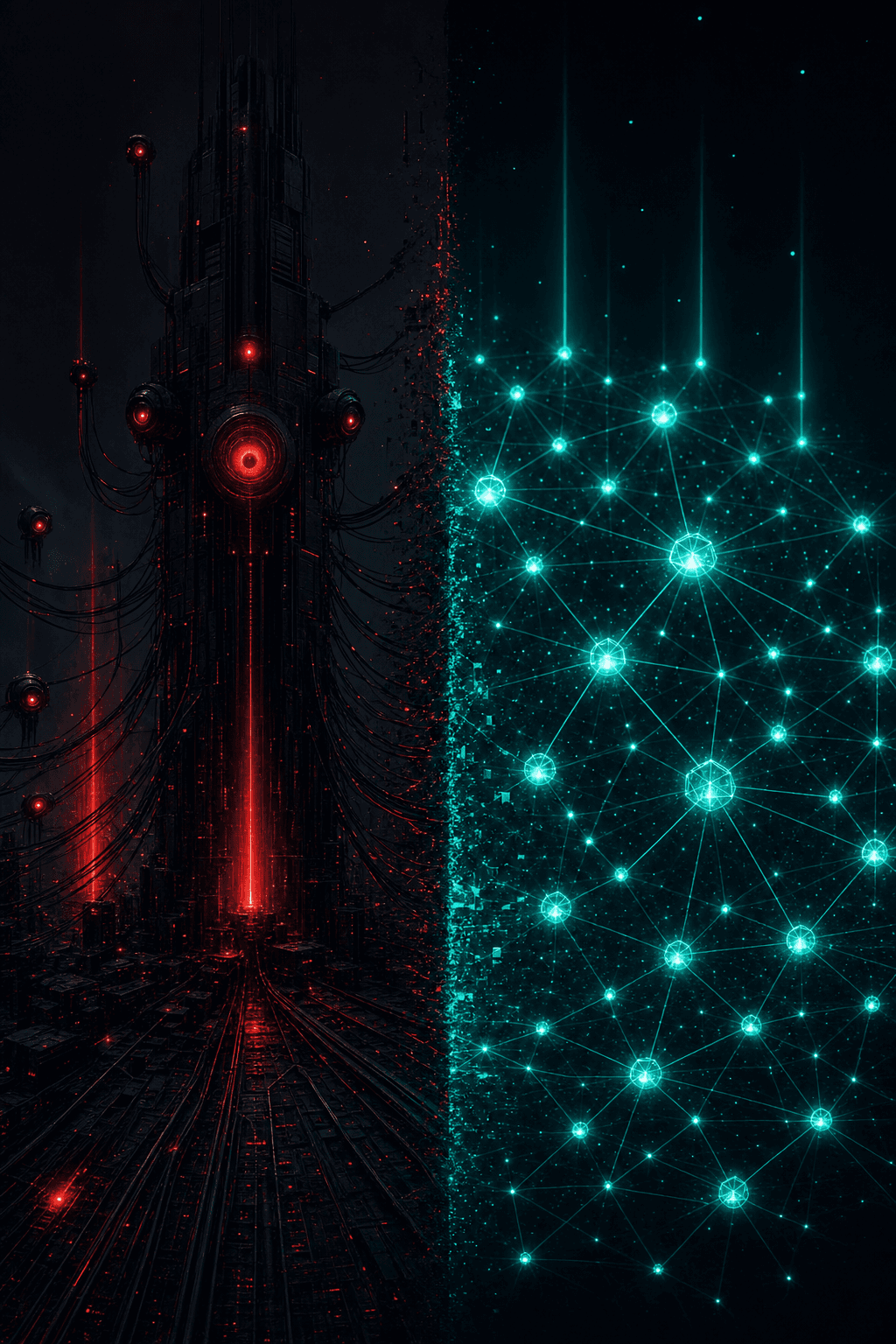
There was a moment, sometime in the early 1990s, when the internet felt genuinely radical. Anyone with a modem could publish. Anyone with a browser could read. The architecture was distributed by design: no center, no gatekeeper, no single point of failure or control. The people who built it didn't just want a faster fax machine. They wanted a communication layer that no government, no corporation, and no institution could own.
That vision didn't exactly fail. It just got... re-platformed. What we have now is technically the same internet, running on the same protocols, but wrapped in a set of centralized services so dominant that using the internet and using their products have become almost synonymous. The promise was open and distributed. The delivery was convenient and controlled.
Five Chokepoints
To understand what happened, follow the chokepoints. Amazon, Microsoft, and Google control roughly 65% of global cloud infrastructure. Your app, your database, your files: most of them run on hardware owned by three companies. If you run a business on the internet, you probably depend on at least one of them. Possibly all three.
Then there's the social graph. Facebook, Instagram, X, TikTok, and YouTube don't just host content. They control who sees it, who gets amplified, and who gets removed. The social graph, meaning the map of who knows whom online, lives entirely on private servers. You can't export it. You can't take it somewhere else. It's theirs.
The ad stack is similarly concentrated. Google and Meta together capture roughly 50% of all digital advertising spend globally. Apple controls the dominant smartphone app store in the West, taking 15 to 30 percent of every digital purchase on iOS. Visa and Mastercard process most of the world's card payments. The "rails" of the internet: compute, identity, distribution, payments: are all privately owned.
What Web3 Promised (And Mostly Didn't Deliver)
Web3 arrived as the corrective. The pitch was compelling: put everything on a public blockchain, remove the middleman, let users own their data and their digital assets. Between 2020 and 2022, hundreds of billions of dollars flowed into projects claiming to rebuild the internet from scratch. Most of them didn't.
The reasons are worth understanding. Many early Web3 projects focused on financialization: tokens, trading, yield. They created new chokepoints in slightly different places. Centralized exchanges became the new banks. Venture-backed DAOs with concentrated token ownership made decisions like boards, not communities. The infrastructure for actually running decentralized applications, the compute, storage, and identity layers, stayed mostly theoretical or depended on centralized services anyway.
Some things did work. Smart contracts proved that self-executing code on a public ledger is viable. DeFi demonstrated that financial services can operate without a bank. NFTs, whatever you think of the aesthetics, proved that digital ownership is technically achievable. But the core problem, that your login is someone else's asset, that your files sit on corporate servers, that your AI tools run on someone else's hardware: that problem remained largely unsolved.
The Infrastructure Problem Is the Real Problem
Here's the thing most Web3 critiques miss: the centralization problem isn't primarily about governance or ownership of tokens. It's about infrastructure. Who runs the servers? Who controls the identity layer? Who processes the compute? As long as the answers are Amazon, Google, and Microsoft, the promise of decentralization is incomplete. This is especially urgent now that AI is accelerating. As we covered in the AI running your life has a landlord, the models shaping your decisions run on infrastructure owned by a handful of companies with their own interests.
Decentralizing the application layer while leaving the infrastructure layer centralized is like putting a different lock on a door that your landlord still owns. You haven't actually gained control. You've just changed the interface.
What Autheo Is Actually Trying to Do
Autheo is an attempt to solve the infrastructure layer directly. Not just to build another blockchain for trading tokens, but to create a full-stack decentralized operating system: compute, storage, identity, AI inference, and a consensus mechanism designed for real-world scale. The detailed explanation of what that means in practice is in the plain-English guide to Autheo. But the short version is this: Autheo wants to be the infrastructure layer the early internet was supposed to have.
Take identity. Instead of logging into every website with a Google or Facebook account, which hands those companies your browsing habits and social graph, Autheo's TheoID is built to give you a self-sovereign identifier you control once it rolls out to mainnet. Take storage. Instead of uploading files to Dropbox or Google Drive and accepting their terms, Autheo's storage layer, delivered through the coming Autheo Marketplace, is designed to distribute encrypted chunks across node operators you can verify. Take compute. Instead of every startup depending on AWS, Autheo's decentralized compute, also delivered through the coming Autheo Marketplace, is built to let workloads run on distributed hardware. These infrastructure layers are rolling out over the coming months following mainnet launch. The market opportunity for this kind of infrastructure is substantial, as detailed in the $500 billion Web3 infrastructure opportunity.
The Multi-Chain Problem (Finally Addressed)
One of Web3's persistent frustrations has been fragmentation. Ethereum, Solana, Avalanche, Polkadot, Cosmos: each has its own developer tools, its own token standard, its own community. Building something that works across chains is still needlessly painful. Autheo's architecture addresses this at the Layer 0 level, meaning it can support multiple chains and virtual machines without forcing developers into a single ecosystem. How this compares to other Layer 0 approaches is covered in depth in the Autheo vs. Polkadot, Cosmos, and Avalanche comparison.
The developer fragmentation problem matters because it's one of the main reasons Web3 hasn't scaled. Great ideas stalled because building across chains required rewriting everything. If you can write once and deploy across multiple execution environments, the barrier drops significantly.
Grounds for Optimism, Carefully Held
The internet's centralization didn't happen because of malice. It happened because convenience beats principle almost every time, and because building distributed systems is genuinely hard. Google was better at search. AWS was easier than running your own servers. Facebook was where your friends already were. The centralized option kept winning on user experience.
That's what's different now. The costs of centralization are becoming visible in ways they weren't in 2010. Platform deplatforming, data breaches affecting hundreds of millions of people, the opacity of algorithmic content decisions, the growing awareness that your digital life runs on infrastructure you have no stake in and no control over. The calculus is shifting.
The original internet vision wasn't naive. It was just early. The infrastructure to actually deliver on it, reliable decentralized compute, sovereign identity, distributed storage, trustless AI inference: that infrastructure is being built now. Autheo's mainnet launched on May 14, 2026. Projects are deploying. The promise isn't delivered yet. But for the first time, the technical path from here to there is clear.
Whether that path gets walked depends on builders, users, and node operators choosing a different model. That's not guaranteed. But the choice is available in a way it wasn't before. If you want to understand the community that built Autheo and why the distributed ownership model matters to them, how 100 co-founders built Autheo is a good place to start.
Gear Up with Autheo
Rep the network. Official merch from the Autheo Store.


Theo Nova
The editorial voice of Autheo
Research-driven coverage of Layer-0 infrastructure, decentralized AI, and the integration era of Web3.
About this author →Get the Autheo Daily
Blockchain insights, AI trends, and Web3 infrastructure updates delivered to your inbox every morning.