



You Can Now Own a Piece of Almost Anything: The Real-World Asset Revolution
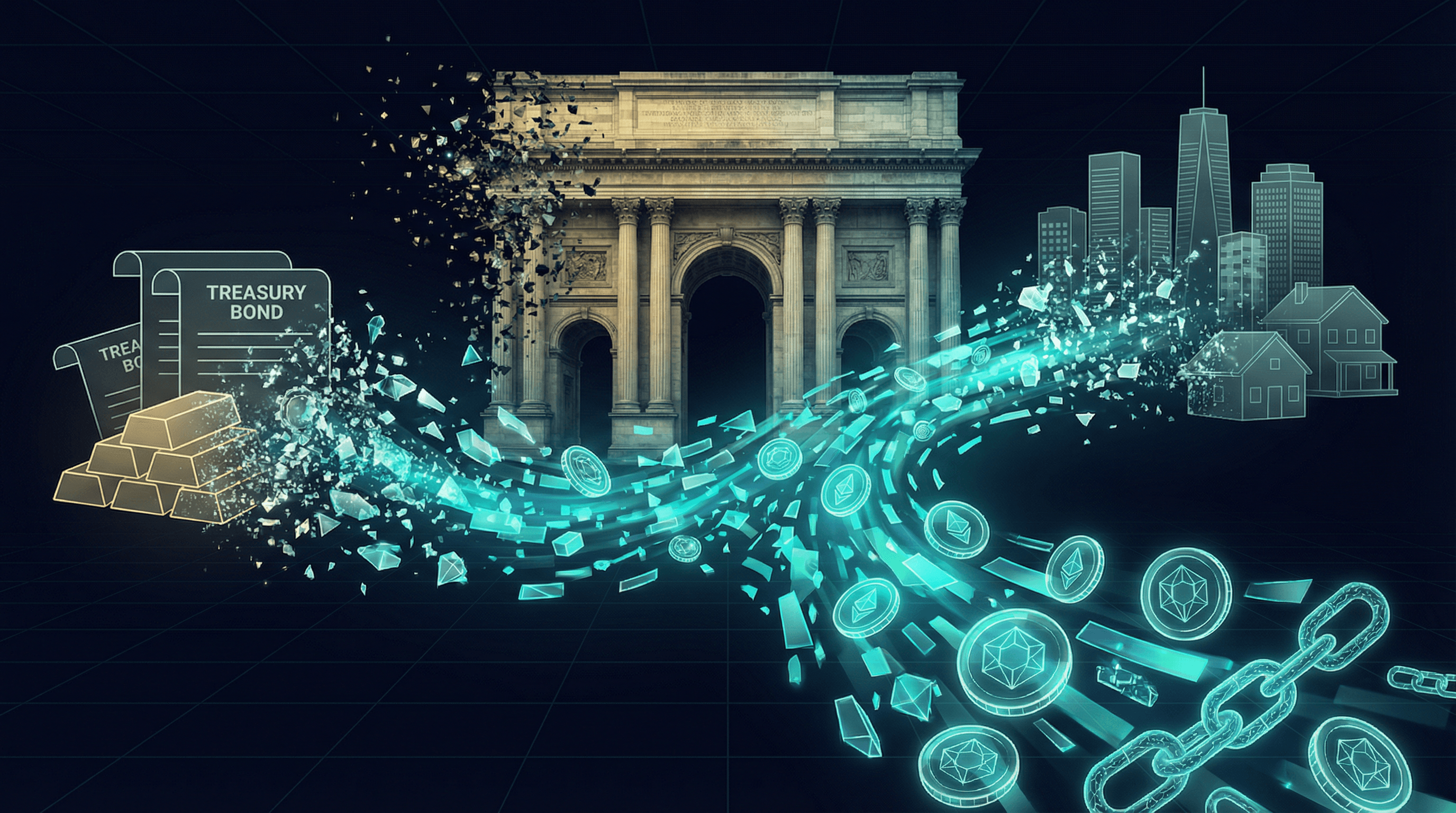
You Can Now Own a Piece of Almost Anything: The Real-World Asset Revolution
Real-world asset (RWA) tokenization is the process of converting ownership rights in physical or financial assets, real estate, gold, government bonds, private loans, into digital tokens on a blockchain. Once something is tokenized, anyone with an internet connection can own a fractional share of it, trade it instantly, and earn yield from it, without needing a broker, a fund manager, or a seven-figure bank account.
The Old World: Investing Was a Members-Only Club
Not long ago, certain investments were simply off-limits to most people. Buying into a commercial real estate deal typically required a minimum of $1 million or more. Private credit funds, where institutions lend directly to businesses at high interest rates, were reserved for endowments, pension funds, and ultra-wealthy individuals. Owning physical gold meant buying bullion, storing it, and insuring it. Treasury bills, while technically available to retail investors, lived inside complex fund structures with management fees and withdrawal windows.
The result was a two-tier investment system. Institutions and the ultra-wealthy accessed the most stable, yield-generating assets on the planet. Everyone else got the stock market, savings accounts with near-zero interest, and, if they were lucky, a mutual fund with a two-percent management fee.
Tokenization is dismantling that wall.
What Tokenization Actually Means in Plain English
Think of it like this. Imagine a $10 million office building. Historically, one entity, a developer, a real estate investment trust, a private equity firm, would own that building outright. With tokenization, a company creates a legal structure (usually a Special Purpose Vehicle, or SPV) that holds the building, then issues one million digital tokens, each representing a $10 stake in the property. Those tokens live on a blockchain, where anyone can buy, sell, or hold them.
The blockchain acts as a shared record book, tamper-proof, always on, and visible to anyone. When the building generates rental income, the smart contract automatically distributes the proportional payment to every token holder. When a token changes hands, the transaction settles in seconds rather than the days or weeks a traditional property transfer would require.
The same logic applies to government bonds, gold bars, corporate loans, and virtually any asset with real value. According to research from InvestaX, tokenization enables near-instant settlement (T+0), reduces counterparty risk, and opens investment access to institutions and individuals previously locked out by high entry minimums.
From $0 to $24 Billion: The Explosive Growth Story
The numbers are striking. According to RWA.xyz data cited by InvestaX, tokenized real-world assets grew to over $24 billion in total value by February 2026, representing 266% growth over the course of 2025. A separate analysis from MEXC research puts the figure at nearly $25 billion, with the market quadrupling in twelve months. At the start of 2025, the total was around $5–6 billion. By the end of the year, it had nearly hit $25 billion.
That acceleration did not happen in a vacuum. Several forces converged at once: clearer regulation in the United States (the GENIUS Act, signed in July 2025, established the first federal stablecoin framework), a wave of institutional product launches, and major infrastructure investments from the largest names in global finance. ByteTree's market analysis notes that the sharpest climb came between September and November 2025, when total RWA value jumped from roughly $10 billion to nearly $20 billion, a doubling in just two months.
What You Can Actually Invest In Today
The tokenized asset market is broader than most people realize. Here is what is live and investable right now, organized by category:
US Treasury Bills and Government Bonds. This is by far the largest category, reaching nearly $9.6 billion in value. T-bills are short-term US government debt, historically the safest investment in the world, and one that paid meaningful yields (4–5%) throughout the high-interest-rate era. Tokenized versions let investors hold on-chain T-bill exposure the same way they would hold a stablecoin, with the added benefit of actually earning yield. Tokenized US Treasury debt expanded from $3.9 billion to $8.9 billion over 2025, a 127% increase.
Gold and Commodities. Gold dominates tokenized commodities, accounting for roughly 70% of the $7 billion tokenized commodity market. Tokenized gold products let investors own a claim on physical gold held in a vault, without the friction of purchasing bullion, arranging storage, or paying a custodian directly. Prices track the spot market in real time.
Private Credit. Tokenized private credit is one of the most interesting categories for yield-hungry investors. Platforms take institutional-grade corporate loans, the kind that traditionally pay 8–12% annually, and issue tokens representing a fractional claim on those loan pools. According to Chainlink's analysis of the space, the global private credit market is valued at over $1.7 trillion, and tokenization is making a meaningful portion of those yields accessible to a broader investor base.
Real Estate. Tokenized real estate is still early-stage compared to treasuries, but it is growing. Platforms are issuing tokens backed by commercial properties, rental portfolios, and mortgage debt. The promise is compelling: the ability to own a fraction of a Manhattan office building or a Miami apartment complex with as little as a few hundred dollars.
Money Market Funds. Traditional money market funds are being tokenized and issued on public blockchains. In September 2025, Fidelity tokenized a $200 million money market fund on Ethereum under the ticker FYOXX, providing institutional investors with on-chain exposure to short-term Treasuries. These products combine the yield of government bonds with the composability of blockchain assets.
BlackRock, JPMorgan, and Fidelity Are Already Here
If you still think of tokenization as a fringe crypto experiment, consider who is building it.
BlackRock, the world's largest asset manager, launched its USD Institutional Digital Liquidity Fund (BUIDL) in early 2024. By late 2025, BUIDL had grown to approximately $2.5 billion in assets, making it the largest tokenized money market fund on public blockchains and accounting for nearly half of all global tokenized US Treasury assets. The fund has since expanded to multiple blockchain networks including Ethereum and BNB Chain.
JPMorgan operates Kinexys (formerly Onyx), its blockchain business unit. Since inception, Kinexys has processed over $1.5 trillion in notional value, with average daily transaction volumes exceeding $2 billion. In late 2025, the bank launched Kinexys Fund Flow, a tool for streamlining alternative fund distribution via blockchain, with a broader rollout planned for 2026.
Fidelity Investments launched its first on-chain tokenized product in August 2025 and has since publicly stated its intention to expand its digital asset and tokenization business. As one of the most trusted names in American retail finance, Fidelity's involvement signals that tokenization is no longer a niche experiment, it is a strategic priority for the mainstream financial industry.
Beyond these three, Franklin Templeton, KKR, Apollo, and Hamilton Lane have all launched tokenized products through platforms like Securitize, which now manages over $4 billion in tokenized assets under management.
The Stock Exchanges Are Joining the Revolution
Perhaps the clearest signal that tokenized assets are becoming mainstream came in January 2026, when the New York Stock Exchange announced plans to develop a dedicated platform for trading and on-chain settlement of tokenized securities. The proposed venue would support 24/7 trading and instant settlement, a dramatic departure from traditional market hours and the current two-day settlement cycle.
Nasdaq moved even further. In September 2025, the exchange filed with the SEC to enable trading of tokenized equities, and in March 2026, it announced an equity token design that would allow companies to tokenize their own shares, integrate programmable corporate governance, and make those tokens available across both regulated exchanges and global blockchain networks. The SEC approved Nasdaq's rule change shortly after, enabling trading of Russell 1000 stocks and major ETFs in tokenized form.
These are not pilots or proofs of concept. These are the world's two most important equity exchanges restructuring their core market infrastructure around blockchain technology.
What Are the Real Risks?
Tokenization is genuinely powerful, but it is not without meaningful risks that every investor should understand before participating.
Liquidity risk is the most underappreciated. Just because an asset has been tokenized does not mean you can easily sell your tokens. Academic research on tokenized RWA markets finds that most tokenized instruments exhibit low trading volumes, long average holding periods, and limited secondary market participation. The infrastructure for buying tokenized real estate or private credit tokens is still being built.
Regulatory risk remains real. Most tokenized assets are classified as securities, which means the platforms offering them must comply with securities laws. Jurisdictions vary widely. A product available to investors in one country may be off-limits in another. Regulatory rules are still evolving, and a change in enforcement posture could affect any given product. Legal analysis from Buzko Legal emphasizes that non-compliance with securities law is the single greatest legal risk for most tokenized asset projects.
Custodial and counterparty risk. A tokenized gold product is only as good as the vault it is backed by. A tokenized real estate token depends on the legal SPV holding the property. If that entity is mismanaged, goes bankrupt, or is fraudulently operated, token holders may find their claims are worth less than expected. Vetting the issuer and custodian behind any tokenized product is essential.
Smart contract and technical risk. Blockchain-based financial products depend on smart contracts, code that executes automatically. Bugs in that code can lead to loss of funds. The more complex the product, the more attack surface exists. Established platforms with security audits and institutional backing carry substantially lower technical risk than untested projects.
The risks are real, but they are not categorically different from the risks that exist in traditional finance, fraud, illiquidity, regulatory change, counterparty default. The difference is that blockchain creates a transparent, auditable record that makes many of these risks more visible and, in some cases, programmably manageable.
Where It Is Heading: The Tokenized Economy
Projections for the tokenized asset market vary, but they all point in the same direction. A report from Ripple and BCG projects tokenization across real-world assets growing from approximately $0.6 trillion in 2025 to multi-trillion-dollar figures over the next decade.
The next phase will likely involve tokenized equities becoming as routine as tokenized treasuries are today, programmable corporate governance where dividends and proxy votes execute automatically on-chain, and cross-border investment markets that operate around the clock without the bottlenecks of correspondent banking.
The more ambitious vision, one that serious institutional players are now backing, is a global capital market that runs on shared, interoperable blockchain infrastructure. Where any asset can be traded against any other, instantly, at any hour, by anyone with proper verification. Where settlement risk effectively disappears because ownership transfer and payment clear simultaneously.
The Infrastructure Layer: Why It Matters as Much as the Assets
Tokenized assets need more than a blockchain to issue tokens on. They need persistent, verifiable data storage (so that the off-chain asset documentation, legal agreements, audit trails, property records, is always accessible and tamper-proof). They need reliable compute infrastructure for the smart contracts and compliance logic. They need identity and KYC systems that can enforce who is and is not eligible to hold a given token.
This is where decentralized infrastructure becomes essential. Platforms built on centralized cloud providers carry concentration risk, a single provider going down or changing its terms of service can disrupt the entire product. Autheo's infrastructure layer addresses this directly. Autheo is building decentralized storage and compute as native components of its platform, with these layers rolling out on mainnet over the coming months to give tokenized asset applications a censorship-resistant, always-on foundation for the data and processing their products depend on. For platforms building tokenized real estate registries, compliant private credit products, or on-chain fund administration tools, that kind of infrastructure is not a nice-to-have, it is a requirement.
As Autheo has previously outlined in its analysis of neutral infrastructure rails for the tokenized economy, the real competition in the tokenization era is not about which assets get tokenized, it is about which infrastructure carries them. Decentralized platforms that offer compliance-ready, politically neutral rails are positioned to become the default settlement and data layer for the industry.
Key Takeaways
Tokenization converts ownership rights in real-world assets into blockchain-based digital tokens, enabling fractional ownership, instant settlement, and 24/7 trading.
The market grew from roughly $5–6 billion at the start of 2025 to over $24 billion by February 2026, a 266% increase in one year.
You can invest today in tokenized US Treasury bills, gold, private credit, real estate, and money market funds, many with entry minimums far below traditional alternatives.
BlackRock (BUIDL: ~$2.5B), JPMorgan (Kinexys: $1.5T processed), and Fidelity have all launched tokenized products, this is now mainstream institutional finance, not crypto experimentation.
The NYSE and Nasdaq are both developing tokenized securities infrastructure, with SEC approval already granted for Nasdaq to trade Russell 1000 stocks in tokenized form.
Key risks include illiquid secondary markets, regulatory compliance requirements, counterparty risk with issuers and custodians, and smart contract technical risk.
The infrastructure layer, decentralized storage, compute, and identity, is as important as the assets themselves, and platforms like Autheo are building the neutral rails the tokenized economy will run on.
To learn more about how Autheo is building the infrastructure layer for the next generation of financial applications, visit autheo.com.
Gear Up with Autheo
Rep the network. Official merch from the Autheo Store.

AUTHEO Gradient Everyday Carry Tote Bag
$30.50

AUTHEO Flat Bill Cap
$25

AUTHEO Large Organic Tote Bag
$30

AUTHEO Notebook
$22.50
Theo Nova
The editorial voice of Autheo
Research-driven coverage of Layer-0 infrastructure, decentralized AI, and the integration era of Web3.
About this author →Get the Autheo Daily
Blockchain insights, AI trends, and Web3 infrastructure updates delivered to your inbox every morning.